
Recoleta is a grid of some 4,600 vaults on five and a half hectares, laid out like a small town: avenues, side streets, corner plots. It is also a maze. The lanes look identical, the signposts are few, and GPS drifts between the marble walls. Most visitors find Evita, take a photo, wander for twenty minutes and leave — having walked past the best tombs in South America without knowing it.
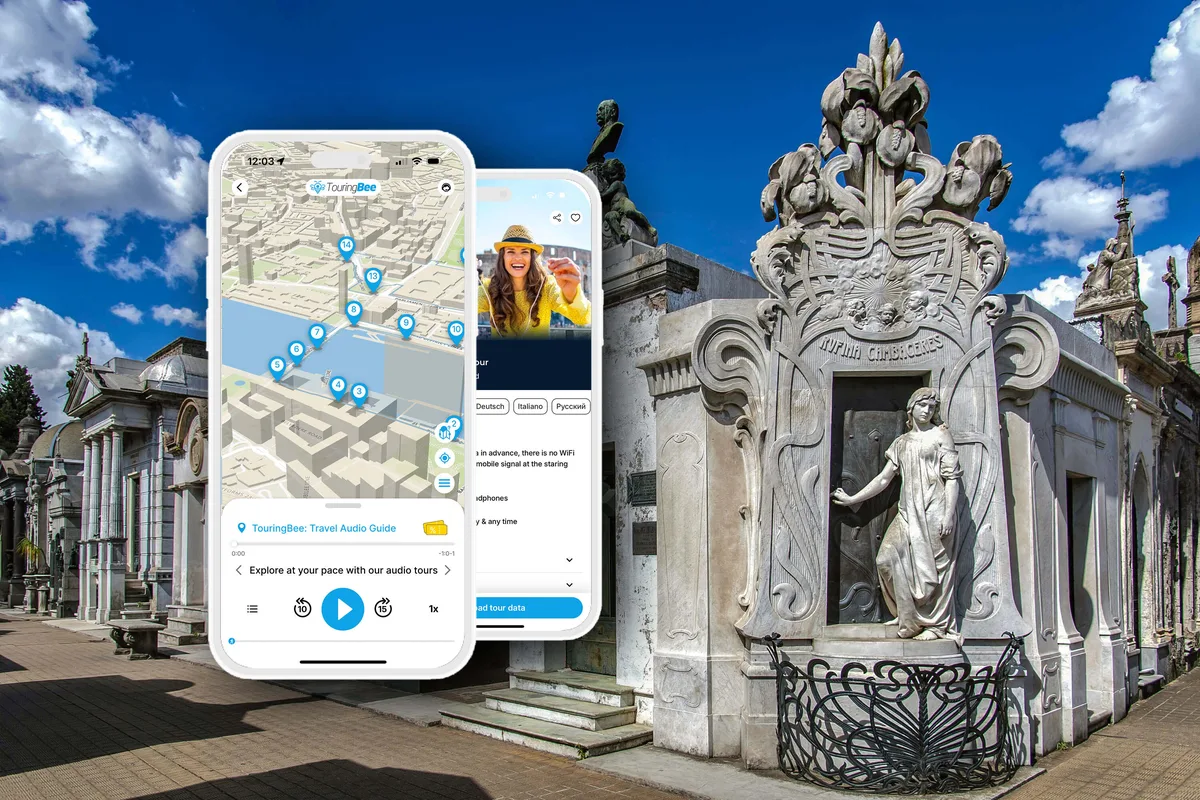
This is the fix: a 22-stop route in walking order, from the portico to the far lanes, with the story that belongs at each stop. It's the same route as the TouringBee Recoleta audio tour, which adds an offline map that shows exactly where you are and a historian's narration you start yourself at each tomb. Use the page to plan; use the app to walk.
Still planning the whole trip? Start with our complete guide to Recoleta Cemetery, then come back here for the route.
The walk at a glance
Get the audio guide →
First, get your bearings
Two landmarks organise everything. The portico is where you start and where you'll come back to. The central crucifix — a big white Christ on a pedestal where the main avenues cross — is your compass: whenever you're lost, walk to the widest lane you can see and follow it until you find him. Photograph each lane intersection after a key stop so you can retrace your steps. The route below moves in a loose loop clockwise, so you're never far from an avenue.
A word about pace. A ten-minute crossing becomes forty the moment a bronze face or a stained-glass dome catches your eye, and that's the point. Set a time budget, then give yourself permission to break it.
The 22 stops, in order
- The porticoStart outside. Requiescant in pace above the columns; an owl, a winged hourglass, a snake biting its tail on the frieze. Every door inside repeats this vocabulary. Inside the gate, turn around: the inscription now addresses the living.
- Basílica del PilarThe 1732 church the friars built, next door and free to enter. It was the cemetery's parish until 1863, when a Freemason called Blas Agüero died unrepentant, the bishop refused him burial, the family went to the president — and Recoleta became a civil cemetery.
- The cenotaph of the three friendsA marble pyramid with three bronze medallions and nobody underneath. A journalist, a poet and a historian built it to their friendship; all three were dead within the year, none of them thirty.
- Admiral William BrownAn Irishman, father of the Argentine navy, under a green column said to be cast from cannons. In 1842 he cornered a young Italian privateer off the coast, watched him burn his own ships rather than surrender, and let him go. The Italian was Garibaldi.
- Mariquita Sánchez de ThompsonAt fourteen she refused the rich old husband her parents chose, petitioned the Viceroy to marry the sailor she loved, and won. Her salon later heard the first performance of the national anthem.
- Guillermo RawsonThe doctor who told Buenos Aires its epidemics came from the crowded conventillos, not from bad luck — and got the city its sewers and running water. Co-founder of the Argentine Red Cross.
- Liliana Crociati de SzaszakA neo-Gothic chapel her mother designed, a bronze Liliana in her wedding dress outside it, her dog Sabú at her feet. She was killed by an avalanche in Austria in February 1970, aged 26. Everyone rubs the dog's nose; almost everyone gets the story slightly wrong.
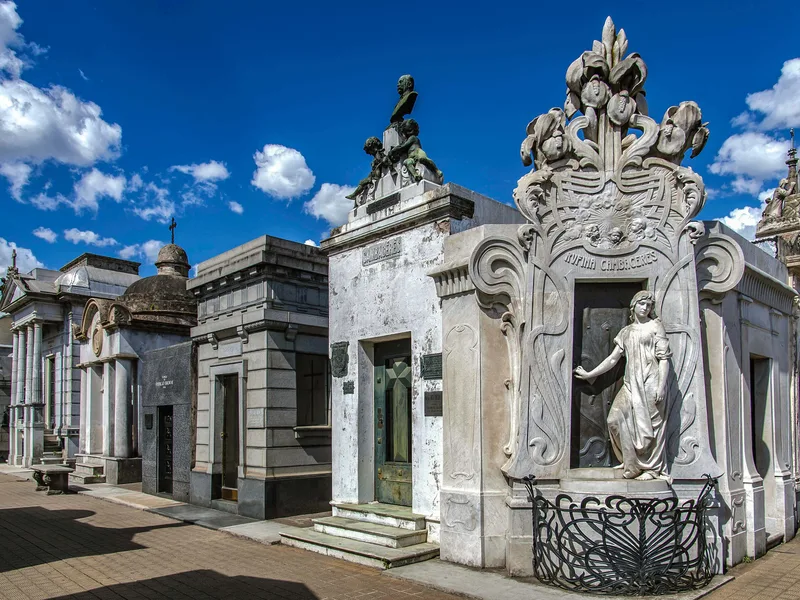
- Rufina CambaceresThe Art Nouveau tomb of a girl who died on her nineteenth birthday in 1902 — carved with one hand on the door. The legend says she woke inside her coffin. The sculpture is why the legend has never died.
- Martín KaradagianThe five-foot-five wrestler who carried two sides of beef up five flights of stairs to get hired, then invented Titanes en el Ring — mummies, Vikings and D'Artagnan fighting live on television for twenty years.
- Eva PerónThe Duarte family vault: black granite, bronze plaques, roses in the grille, and a coffin several metres down. Sixteen years hidden, a false name in Milan, a dining room in Madrid, and home in 1976. Full story →
- Francisco Javier MuñizIn 1844, with the vaccine supply gone, this army surgeon inoculated the city with lymph from his own baby daughter's arm. Thirty years later he went out to treat yellow fever and died of it.
- David AllenoThe caretaker. Twenty-eight years sweeping these lanes, saving for a plot among the presidents, and a statue of himself with keys, broom and watering can. The tour tells you the suicide legend; the death certificate says 1915 and doesn't confirm it.
- Luis Ángel FirpoThe Wild Bull of the Pampas, life-size in his robe. In 1923 he knocked Jack Dempsey clean out of the ring at the Polo Grounds; the referee counted slowly, reporters pushed the champion back in, and Argentina has never forgiven any of them.
- Toribio AyerzaA dynasty of doctors — the first tracheotomy in Argentina, a heart disease that bears the family name — and a grandson kidnapped by the Rosario mafia in 1932, killed because a coded telegram said “kill” instead of “send”.
- Salvador María del CarrilA vice-president and his wife, Tiburcia, who didn't speak to each other for thirty years after he announced in the newspapers that he wouldn't pay her debts. Their statues face opposite directions. She arranged that.
- Carlos MenditeguyPolo champion, world junior tennis champion, scratch golfer in nine months on a bet, Formula One driver, and the man who skipped a Grand Prix for the Riviera with Brigitte Bardot. “An opportunity not to be missed.”
- Victoria OcampoFounder of Sur, publisher of Borges and Camus, first Argentine woman at the Nuremberg trials, jailed by Perón for 26 days at the age of 63. The family crypt is plain; the life was not.
- Luis Federico LeloirNobel Prize in Chemistry, 1970, for the sugar nucleotides — and the inventor, at fourteen, of salsa golf, mayonnaise and ketchup, which he regretted not patenting. The Art Nouveau vault with the mosaic dome predates the prize by sixty years.
- Armando BóThe director who put the first nude woman on an Argentine screen — his lover and muse Isabel Sarli — by promising her a flesh-coloured swimsuit and a very distant camera. The lens had a zoom.
- Ramón SantamarinaAn orphan at eight, a stowaway at sixteen, a wagon-driver in Tandil, and eventually the owner of twenty-six estancias, a bank and sixteen children. A rags-to-riches story with a dark bookend.
- Raúl AlfonsínThe president who ended the dictatorship in 1983 and inherited 200% inflation. His tomb, with a bust by Luciano Garbati, was inaugurated on 30 October 2009 — the anniversary of his election.
- Benjamín Solari ParraviciniThe painter whose sketches, he said, were guided by a voice: television, the atomic bomb, a man on the moon, drawn decades early. Argentina's Nostradamus, and the end of the route.
Hear the stories at the tombs themselves
22 stops, offline map, English or Spanish narration — from €9.99, one payment, no subscription.
Get the audio guideThe 45-minute version
Short on time, or too hot to linger? Do stops 1, 4, 7, 8, 10, 12 and 13 — the portico, Admiral Brown, Liliana, Rufina, Evita, the caretaker and the boxer — then walk back to the crucifix and out. You'll have seen the four styles, the two great legends, the most visited grave in Argentina and the most human one.
Tips for the walk
- Download first. Get the app and the tour on hotel Wi-Fi. Inside, the marble blocks both data and GPS in places; an offline map still shows the route even when the blue dot hesitates.
- Look up and through. The best details are above eye level or behind glass doors — stained glass, mosaic ceilings, spiral stairs going down three floors. Use your phone's zoom rather than leaning on the door.
- Read the doors. Hourglass, inverted torch, wreath, butterfly, anchor: each is a sentence about the family inside. Don't over-read “Masonic” symbols — most are Catholic allegory.
- Yield to mourners. It's a working cemetery. If a family or a funeral is in a lane, take a different stop first and come back.
- The cats. There used to be dozens; volunteers have rehomed most. If you see one, enjoy it from a distance and don't feed it.
- Afterwards. La Biela café and the giant gomero tree are two minutes from the gate; the basilica is next door and free.
Why walk it with the audio guide
Everything above is on this page for free. What the page can't do is stand in the lane with you. The TouringBee tour has the 22 stops on an offline map, so you always know where the next one is; each stop is a recording of three to five minutes, written by a professional historian, that you start yourself when you arrive — so you're never rushed and never behind a group's umbrella. It's narrated in English and Spanish, works on iPhone and Android, and you keep it for a year. It costs less than the entry ticket.
Recoleta Cemetery Self-Guided Audio TourInstant access
- 100% offline — no Wi-Fi or data needed inside the cemetery
- Offline map with the route — you start each story yourself at the tomb
- Narrated in English and Spanish
- Works on iOS & Android
- 22 stops, about 1–2 hours at your own pace
The takeaway
Start at 9:00, use the crucifix as your compass, and walk the stops in order so the crowded ones fall before the crowds. Give Recoleta ninety minutes and it gives you a national history in marble.
And if you want the stories told at the tombs themselves, in your ear, at your pace — that's exactly what the audio guide is for. Get the audio guide — €9.99
Frequently asked questions
How long does the self-guided walk take?
About 90 minutes at a relaxed pace for all 22 stops, with time to look. The essentials — gate, Brown, Liliana, Rufina, Evita, Alleno, Firpo — fit into 45 minutes.
Do I need a guide to visit Recoleta Cemetery?
No. The cemetery is fully open to independent visitors. What you need is a way not to get lost and someone to tell you the stories — a map and an audio guide do both, at your own pace.
Can I get lost in Recoleta Cemetery?
Easily. It's a grid of some 4,600 vaults on five and a half hectares, the lanes are almost identical, and GPS drifts between the tall stone walls. Use the central crucifix as your compass and download an offline map before you enter.
Is the route wheelchair or stroller friendly?
The lanes are paved but uneven, with occasional steps and very narrow passages. The main avenues are manageable; some side lanes on this route are not. Ask at the Junín 1750 entrance about assistance.
What's the best order — Evita first?
No. Evita's lane is mobbed from mid-morning; visit her as stop 10, on the way, or go there first only if you're at the gate at 9:00. The route above is built so the crowded stops fall where the crowds aren't yet.
Does the audio guide follow this route?
Yes — the 22 stops here are the 22 stops of the TouringBee Recoleta audio tour, in the same order, with an offline map that shows where you are.
Continue exploring
Some links on this page are affiliate links (GetYourGuide, Booking.com, TouringBee). If you book through them we may earn a small commission — at no extra cost to you. It never affects what we recommend. See our Affiliate Disclosure.