The first thing you notice in Recoleta is that it doesn't feel like a cemetery. It feels like a neighbourhood: streets, corner plots, house numbers, front doors. Then you start reading the names on the doors and realise it is a neighbourhood — the one where Argentina keeps its presidents, generals, scientists, writers, a champion boxer and one cemetery caretaker who saved for decades to move in.
This page helps you decide whose graves are worth looking for: who the person was, why they matter, what the tomb looks like and roughly where it stands. Once you're inside, the TouringBee audio guide joins 22 of them into one ready route: an offline map leads from vault to vault, and each door starts its own story. Here is the cast list. There is the play.
Still planning the whole trip? Start with our complete guide to Recoleta Cemetery, then come back here for the who's who.
Recoleta's residents at a glance
Get the audio guide →
Where the main graves are: a free sketch
For anyone walking it alone. Two landmarks organise everything: the main gate on Junín, and the big white crucifix at the centre where the main avenues cross.
- The main gate (portico)Start here. Ask security for a paper map — there isn't always one.
- Pantheon of Meritorious CitizensJust inside, along the central avenue: the civic pantheon of the young republic.
- The central crucifixEnd of the central avenue. Your compass; everything below is measured from here.
- SarmientoAlong the wide avenue from the crucifix; the obelisk with the condor is visible from a distance.
- MitreNear Sarmiento, on the same axis of main avenues.
- Eva PerónLeft from the crucifix, a few short blocks, then into a narrow side lane; look for “Familia Duarte” and, by day, a small crowd.
- Admiral BrownThe green column, visible from the main avenue in the first part of the cemetery, towards the basilica.
- LeloirA tall Art Nouveau façade with a mosaic dome, in the middle section.
- FirpoThe boxer's statue in his robe by a granite mausoleum; in the side lanes beyond Evita.
- Rufina CambaceresThe girl at the door, off the main axes; from here most people head back to the chapel and the exit.
The sketch gives directions, not turn-by-turn: Recoleta's lanes repeat, and this list takes about ninety minutes the first time. Photograph each intersection after a stop so you can find your way back.
How to read this cemetery
A vault in Recoleta is a family's argument about how it wanted to be remembered. A general gets trophies and eagles; a judge gets scales; a child gets flowers and an angel. Corner plots are the showy ones — more façade, better light, a ceremonial approach. Busts turn politicians into permanent public speakers. Once you see that, every door becomes a sentence, and the names below read as neighbours, rivals and in-laws rather than a list.
The presidents
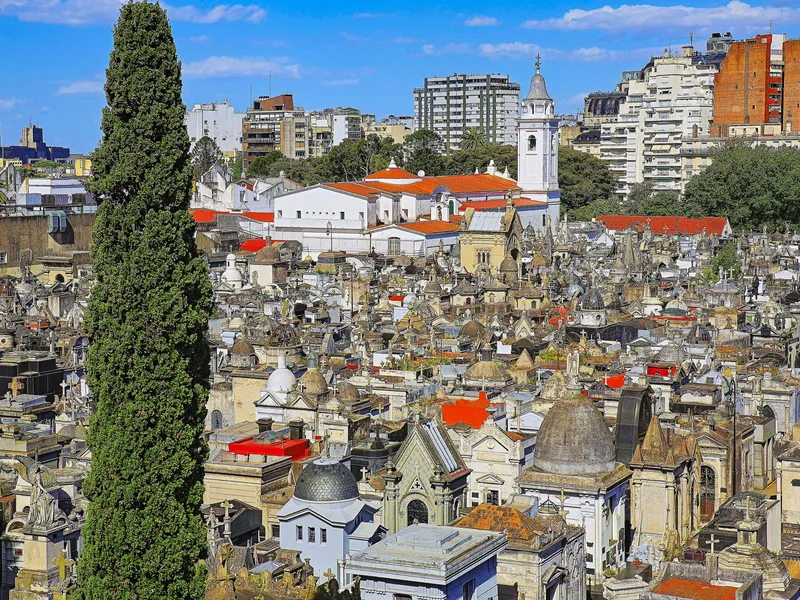
At least eighteen Argentine presidents are buried here, and the way each one is staged tells you as much as the biography.
Domingo Faustino Sarmiento (1811–1888)
President, schoolteacher, architect of the national school system. Victor de Pol gave him not a house but an obelisk, crowned with a condor, and a French sentence carved into it: On ne tue point les idées — ideas cannot be killed. Look for the reliefs of children and books. One of the most eloquent political statements in the cemetery, next to some of its quietest neighbours.
Bartolomé Mitre (1821–1906)
President, general, historian, founder of the newspaper La Nación. The vault was rebuilt in 1938 in Art Deco with allegories of Duty, Argentina and Justice. Compare him with Sarmiento: one a man turned into landscape, the other a public office surrounded by virtues. Two ideas of a nation, a few steps apart.
Raúl Alfonsín (1927–2009)
The president under whom Argentina returned to democracy in 1983 after the military dictatorship. His modern memorial is easy to recognise by the bust by Luciano Garbati. The economic crisis the new government walked into is one of the audio guide's stops.
Julio Argentino Roca, Pedro Aramburu and the others
Roca, president and general, led the 1878–85 military campaign in Patagonia known as the “Conquest of the Desert”; Argentina still argues whether to read it as settlement of the territory or as the violent dispossession of Indigenous peoples, and his heroic monument sits in the middle of that argument. Pedro Aramburu is the general who overthrew Perón in 1955; his story crosses Evita's again after her death — and crosses it once more here, in Recoleta. Carlos Pellegrini, Hipólito Yrigoyen (twice president, and the fiancé in the Rufina legend), Marcelo T. de Alvear, José Figueroa Alcorta and a dozen more are within a few minutes' walk.
Independence, war and the sea
Admiral William Brown (1777–1857)
An Irishman from County Mayo who founded the Argentine navy. Look for the tall green Corinthian column with ship imagery and a bronze urn. One of Brown's best stories involves an unexpected encounter with a man who later became a national hero of Italy. The rest is at the column, in the audio guide.
Remedios de Escalada (1797–1823)
Wife of José de San Martín, the liberator. She died at 25, one of the cemetery's earliest burials, while her husband was fighting for South America's independence. San Martín himself is not here — he lies in the Metropolitan Cathedral — so her modest grave is the closest Recoleta comes to him.
Manuel Dorrego (1787–1828)
Governor of Buenos Aires, shot in 1828 after a coup by his rival Lavalle. One of the cemetery's first political martyrdoms. There would be more.
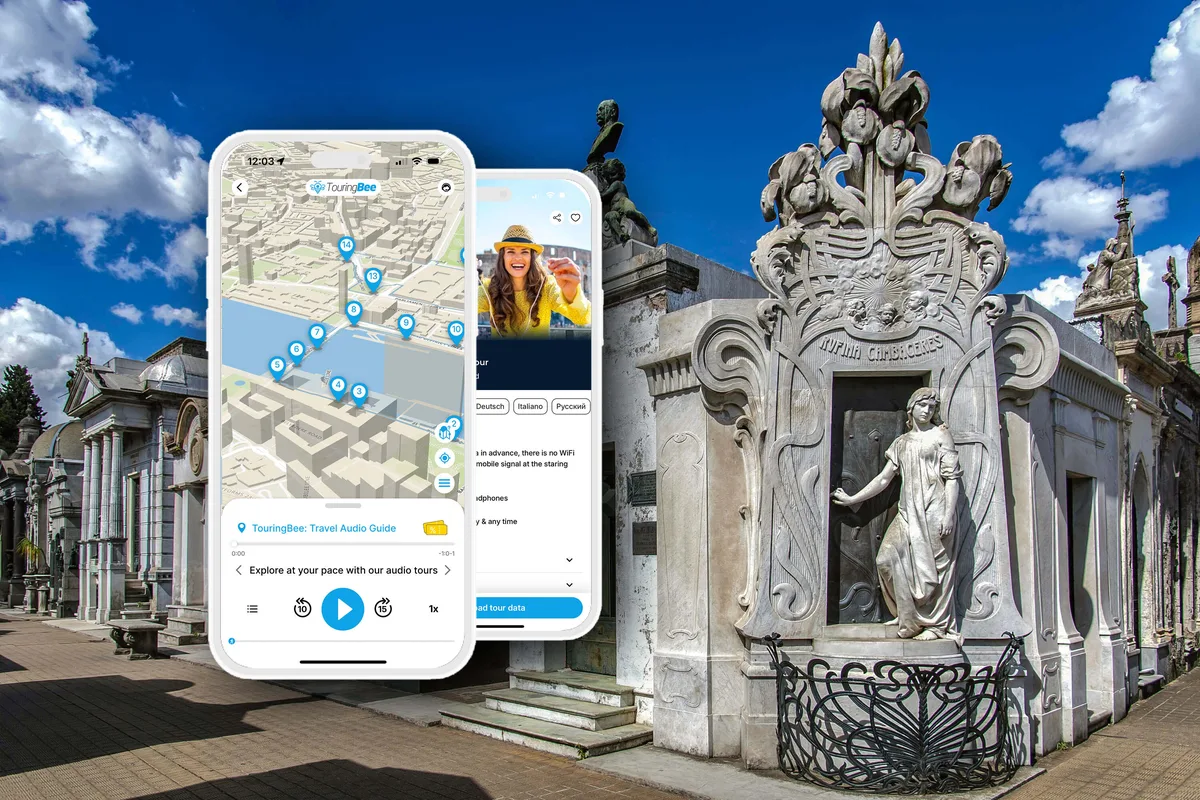
Hear the stories at the tombs themselves
22 stops · ~1.5 h · offline map — from €9.99, one payment, no subscription.
Get the audio guideScience and medicine
Luis Federico Leloir (1906–1987)
Nobel Prize in Chemistry, 1970, for discovering sugar nucleotides — the chemistry of how the body turns carbohydrates into energy. The family vault is unmistakable: a tall Art Nouveau façade, ironwork, a mosaic dome with Christ and angels, sixty years older than the prize. Leloir is also credited with a sauce every Argentine keeps in the fridge. Which one, and why he regretted it, is a story for the tomb.
Carlos Saavedra Lamas (1878–1959)
Argentina's first Nobel laureate — the Peace Prize, 1936, for mediating the end of the Chaco War between Bolivia and Paraguay. Often forgotten next to Leloir. Wrongly.
Guillermo Rawson, Francisco Javier Muñiz and the Ayerza family
Three medical stories — epidemics, first operations, and one family tragedy that began with a kidnapping. Their vaults are easy to walk past, yet together they cover almost a century of Argentine medicine. On the TouringBee route they are one of the strongest blocks.
Not here: Bernardo Houssay, the 1947 Nobel laureate in medicine, is buried in Chacarita. He is often added to lists of “Recoleta's Nobel winners” by mistake.
Writers and the cultural elite
Victoria Ocampo (1890–1979)
Founder of the magazine Sur, one of the most important literary projects of twentieth-century Latin America, through which Borges, Camus and Cortázar reached readers. Her family crypt is surprisingly modest for a woman who argued with Mussolini and published a generation of great writers. The life was much louder than the monument.
Silvina Ocampo and Adolfo Bioy Casares
Victoria's sister and her husband, author of The Invention of Morel and Borges's closest collaborator. The interior faces west and is best read through the glass in late-afternoon light — one more reason to come back after 15:30.
José Hernández (1834–1886)
Author of Martín Fierro, the poem that made the gaucho a national figure. His tomb is a historic monument; the book is the reason.
Sport, screen and the ring
Luis Ángel Firpo (1894–1960)
The Wild Bull of the Pampas, the first Latin American to fight for the world heavyweight title. His life-size statue in a robe stands at the door of a granite mausoleum. In 1923 he literally threw the champion, Jack Dempsey, out of the ring — a moment Argentina argued about for decades. Why Dempsey won anyway, and what happened between the two men afterwards, is told at the mausoleum.
Martín Karadagian (1922–1991)
A five-foot-five wrestler who created Titanes en el Ring, the show that had mummies, Vikings and D'Artagnan fighting on Argentine television for twenty years. How he got his first job involves two sides of beef and five flights of stairs.
Armando Bó (1914–1981)
The director who pushed the limits of what Argentine cinema could show, together with the actress Isabel Sarli. Often confused with his grandson and namesake, the Oscar-winning screenwriter of Birdman.
Carlos Menditeguy (1914–1973)
Polo, tennis, golf and Formula One — all in one biography. One day personal plans mattered more to him than a Grand Prix, and his reply to the team became almost as famous as the story itself.
The legends
Three tombs draw more visitors than most presidents, and each has a story guides tell in slightly different, slightly wrong versions. Rufina Cambaceres, who died on her nineteenth birthday in 1902 and is carved at her own door, one hand on the handle — the city has told the story of her waking inside the coffin ever since. Liliana Crociati, killed by an avalanche in Austria in 1970, in bronze in her wedding dress with her dog Sabú, whose nose is polished gold by hands. David Alleno, a caretaker who swept these lanes for twenty-eight years and had himself carved with his keys, broom and watering can. What the documents say about each — and where the legends went wrong — is its own article: the legends of Recoleta Cemetery.
And Evita
Eva Perón is Recoleta's most famous grave, but looking for the name Perón is useless: she lies in the Duarte family vault, in a narrow side lane, behind a black granite door covered in bronze plaques. Why her body came back to Argentina only many years after her death deserves its own telling. How to find Evita's tomb, and what happened to her →
Who is not buried in Recoleta
Because it is asked at the gate every hour: Juan Perón is in San Vicente. Jorge Luis Borges is in Geneva, by his own choice. Carlos Gardel, the tango singer, is in Chacarita. San Martín is in the Metropolitan Cathedral on Plaza de Mayo. Diego Maradona is in a private cemetery in Bella Vista. Recoleta is the cemetery of the old elite; Chacarita, across the city, is where the people's heroes went.
What the list doesn't tell you
Between the famous doors are the ones nobody photographs, and they stayed with me longer. Vaults with broken glass, where you look down and see a spiral staircase going into the dark, coffins lowered into the basement, a ribbon rotted to thread. Below the lane there can be several floors and dozens of coffins; the façade is only the lid. Then, on the roof of the next mausoleum, a cat asleep in the sun, entirely unbothered. Recoleta is a working cemetery, and its residents are still being moved, sold, restored and forgotten. The famous graves are the reason you come; the ordinary ones are why you stay.
One more thing I learned the hard way: come at 9:00. The lanes are empty and the morning light comes in low across the reliefs. The sketch above shows where the big names stand; the audio guide walks you between 22 vaults in the right order and tells each story at the door.
Recoleta Cemetery Self-Guided Audio TourInstant access
- 100% offline — no Wi-Fi or data needed inside the cemetery
- Offline map with the route — you start each story yourself at the tomb
- Audio languages: English, Spanish
- Works on iOS & Android
- 22 stops, about 1–2 hours at your own pace
The takeaway
Recoleta is not a list of famous names; it is a city where the names are neighbours. Sarmiento next to his rivals, Evita a few lanes from the general who overthrew her husband, a caretaker among the presidents he swept for. Read the doors, use the crucifix as your compass, and give it ninety minutes.
And if you want each of these people to speak when you reach them — the admiral, the boxer, the Nobel laureate with the sauce — that is what the audio guide is for. Get the audio guide — 22 stops · offline · €9.99
Frequently asked questions
How many famous people are buried in Recoleta Cemetery?
The City lists more than 200 notable Argentines interpreted on its tours, including at least 18 presidents, in some 4,600 vaults. More than 90 vaults are national historic monuments.
Who is the most famous person buried in Recoleta?
Eva Perón, in the Duarte family vault. After her: presidents Sarmiento and Mitre, Admiral William Brown, Nobel laureate Luis Federico Leloir, writer Victoria Ocampo and boxer Luis Ángel Firpo.
Is Juan Perón buried in Recoleta too?
No. Juan Perón is buried at his family's estate in San Vicente, outside Buenos Aires. Only Eva lies at Recoleta, under her maiden name Duarte.
Is Borges buried in Recoleta?
No — Jorge Luis Borges is buried in Geneva. Carlos Gardel is in Chacarita, San Martín in the Metropolitan Cathedral, and Nobel laureate Bernardo Houssay in Chacarita. They are often added to Recoleta lists by mistake.
How do I find a specific grave?
Ask at the gate for a map, use the central crucifix as your compass, and follow the sketch on this page. If you'd rather walk without searching, the TouringBee audio guide has 22 tombs already marked on an offline map and set in walking order.
Are the vaults open to the public?
No. Every vault is private family property. You look through the doors and glass from the lane; you never step inside.
Continue exploring
Some links on this page are affiliate links (GetYourGuide, Booking.com, TouringBee). If you book through them we may earn a small commission — at no extra cost to you. It never affects what we recommend. See our Affiliate Disclosure.