
Recoleta is the neighbourhood Buenos Aires built when it decided, in the 1880s, to look like Paris. Mansions with mansard roofs, a boulevard called Alvear, embassies in palaces, a café under a fig tree older than the republic — and at the centre of it all, a cemetery that is one of the city's main attractions. Many people come to the barrio for the cemetery alone and leave straight after. That's a pity: almost everything worth seeing in Recoleta is within ten minutes' walk of its gate.
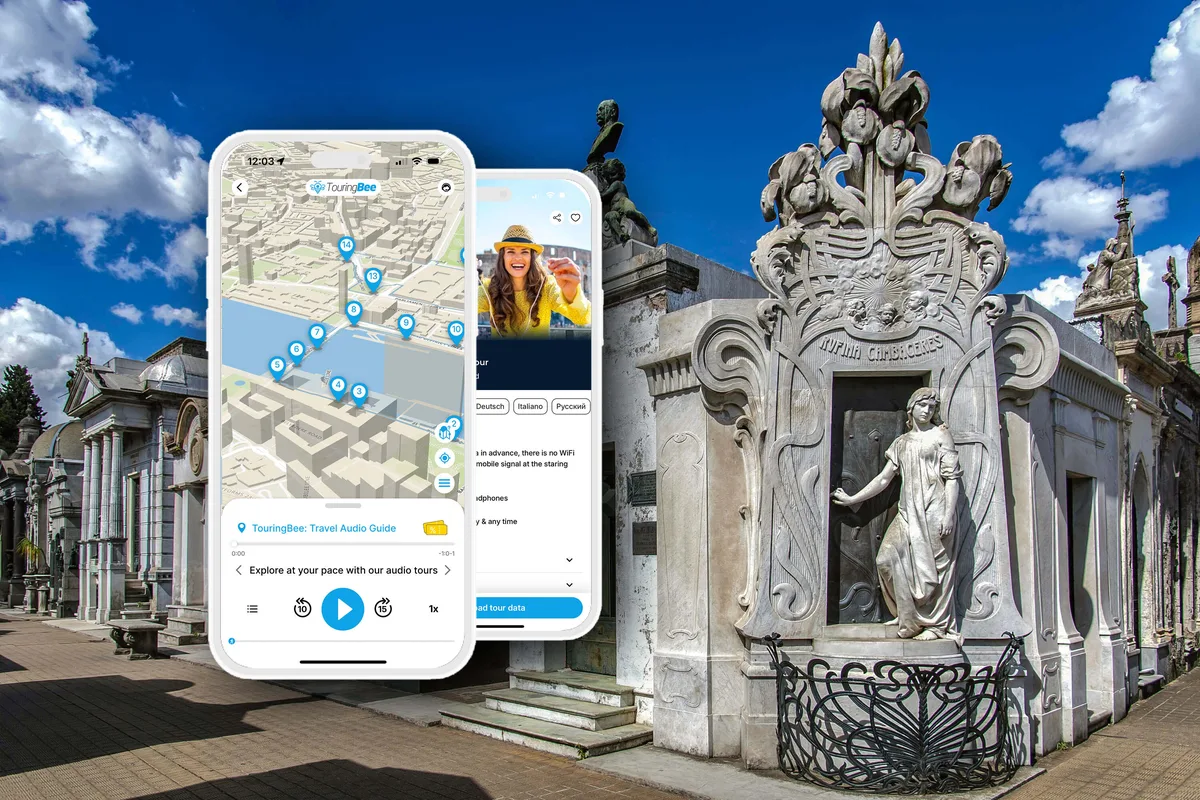
This guide covers what's actually worth your time in the barrio, with hours and prices as of 2026, a map, and two half-day plans at the end — one for weekdays, one for weekends, because the craft fair and the cultural centre's hours make them different days. Start with the cemetery: TouringBee joins its 22 most interesting tombs into a ready route of about an hour and a half. The offline map leads you from one to the next, and the stories start right at the graves — no group, no timetable.
First time at the cemetery? Open our complete guide first: tickets, entry, Evita's grave and the practical advice. This page is about what's around it.
Recoleta at a glance
Get the audio guide →
1. Recoleta Cemetery
The reason the barrio is on tourist maps at all: 4,600 vaults on five and a half hectares, laid out in streets and blocks, housing presidents, generals, Nobel laureates, a champion boxer and Eva Perón. Open 9:00–17:00 every day; non-residents pay an entry fee, Argentine residents enter free. Travellers who have filmed and written about their visits agree on one thing: the first hour after opening is usually the calm one, so aim for 9:00 and give it ninety minutes. Everything you need — tickets, how to find Evita, who's buried where — is on this site; the stories at the tombs are in the audio guide.
2. Basílica Nuestra Señora del Pilar
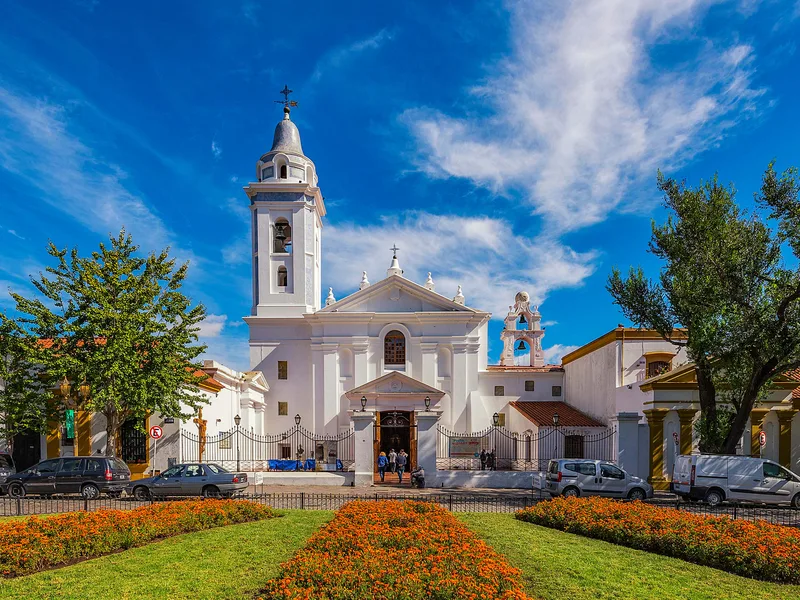
Next door to the cemetery gate, white, low and plain outside, and one of the oldest churches in Buenos Aires: the Recollect Franciscans finished it in 1732, when this was orchard land at the edge of town. Inside is the surprise — colonial altarpieces, a silver-fronted high altar, and a quiet you won't find anywhere else on the block. Entry to the church is free; dress as you would for any working church. The former convent rooms behind it hold the Museo de los Claustros, a small museum of the friars' colonial world with a charge at the door and hours that change — check before you plan around it. Why the church lost control of the cemetery in 1863, over the burial of a Freemason, is a stop on the audio route.
3. Centro Cultural Recoleta
The other half of the friars' convent — later a hospital, an asylum and barracks — converted in 1980 by Clorindo Testa into a contemporary arts centre with a packed programme: exhibitions, photography, installations, free concerts and events. Its terraces give a rare free view from above onto the cemetery roofs and the basilica dome; visitors often name that view as the reason to go in. Junín 1930; Tuesday to Friday 13:30–22:00, weekends and holidays 11:30–22:00, closed Mondays. The building is free to wander; some exhibitions charge non-residents a small fee.
4. Plaza Francia and the weekend craft fair
The lawns that slope down from the cemetery wall to Avenida del Libertador are two squares with three names: Plaza Francia, Plaza Intendente Alvear, and — to everyone in Buenos Aires — simply “la Recoleta”. On Saturdays, Sundays and public holidays, from about 11:00 to 20:00, the Feria de Plaza Francia fills them with stalls of leather, silver, ceramics, mate gourds and knitwear. It's a registered feria artesanal: the rule is that everything is handmade by the person selling it, so there's no imported souvenir tat. Buskers, mate circles on the grass, dog walkers with a dozen leads. On weekdays, without the fair, the square is much quieter and locals use the lawns to sit, read and share mate.
5. La Biela and the gomero
At the top of the square, opposite the cemetery gate, the terrace of La Biela sits under the Gran Gomero — a rubber fig that is by every account more than two hundred years old (the city dates it to the late 18th century, and it is protected as a historic tree) and whose horizontal branches, up to 30 metres long, are propped on steel crutches and shade half the terrace. The café has been the barrio's living room since the 1950s, when racing drivers (a biela is a connecting rod) made it their headquarters; two of them, Fangio among them, sit at the door in fibreglass. The coffee is expensive and the terrace costs a surcharge. Pay it. It's the spot for the 8:45 coffee before the cemetery opens, and the place to recover afterwards.
Hear the stories at the tombs themselves
22 stops · ~1.5 h · offline map — from €9.99, one payment, no subscription.
Get the audio guide6. Museo Nacional de Bellas Artes
Across Avenida del Libertador, five minutes from the cemetery, the country's main fine-arts museum — and it's free. European holdings strong on Impressionism and the 19th century (Manet, Monet, Degas, Rodin, Van Gogh), and a full survey of Argentine art. Av. del Libertador 1473; Tuesday to Friday 11:00–20:00, Saturday and Sunday 10:00–20:00, closed Mondays. Allow an hour. If you have less, the Argentine rooms on the first floor are the ones to see: from the 19th century and its images of the gaucho to Antonio Berni and Xul Solar.
7. Floralis Genérica
Five minutes further along Libertador — about ten from the cemetery — in Plaza de las Naciones Unidas, a 20-metre flower of stainless steel and aluminium. In normal operation it opens its six petals at about 8:00 every morning and closes them at sunset, as a real flower would; on a few national holidays it stays open all night. The architect Eduardo Catalano gave it to the city in 2002. The mechanism has been repaired more than once — most recently after a storm tore petals off in late 2023 — so the position of the petals may differ from the schedule. Best photographed in the morning with the petals open, or at dusk as they close with the red glow inside. Free, always.
8. Avenida Alvear and the Belle Époque
Seven blocks of the Buenos Aires that called itself the Paris of the South: the Palacio Duhau (now a Park Hyatt, with a garden café open to anyone), the Alvear Palace Hotel, the Jockey Club, the Papal Nunciature in the former Fernández Anchorena palace, and the apartment buildings in between, every one with a French roof. It's a separate walk rather than part of the cemetery circuit: if you carry on after lunch, go up to Plaza Carlos Pellegrini and come back towards the cemetery along Alvear — the façades line up best in that direction. It's the one street where the comparison with Paris doesn't sound like marketing.
9. El Ateneo Grand Splendid
Technically just over the barrio line on Avenida Santa Fe, and fifteen minutes' walk from the cemetery, but on every Recoleta list for a reason: a 1919 theatre with its boxes, frescoed dome and red curtains intact, turned into a bookshop in 2000. The stage is a café. The boxes are reading nooks. Entry is free and nobody minds if you don't buy; it's the natural end of the day and the place to pick up José Hernández's Martín Fierro or a Bioy Casares after you've seen their graves.
Also in the barrio
- Facultad de Derecho — the law faculty's Greek temple opposite the Floralis; the Subte H station “Facultad de Derecho” is the nearest to the flower.
- Palais de Glace — the 1910 ice rink turned exhibition hall on Posadas, worth a look if an exhibition is on.
- Museo Nacional de Arte Decorativo — a 1911 palace on Libertador with its original interiors, a short walk past the Bellas Artes.
- Recoleta Mall (Vicente López 2050, behind the cemetery) — for a cash machine, a bathroom or a cold drink. The old Buenos Aires Design next to the Centro Cultural is being rebuilt as an open-air mall, “OH! Buenos Aires”; the opening has been postponed several times, so check before you count on it.
Where to eat
La Biela for the terrace, not the food. For a proper lunch, the streets behind the cemetery — Vicente López, Azcuénaga, Junín — have the barrio's parrillas and old-school cafés; the restaurant strip on R.M. Ortiz beside the fair is convenient, tourist-priced and fine for a beer under the trees. Ice cream is the Recoleta food group: there seems to be a heladería on every second corner, and dulce de leche is the flavour to order.
Tours and tickets
The cemetery is the place in Recoleta where historical context matters most: without it, it's easy to see dozens of beautiful vaults and never learn whose stories stand behind them. TouringBee's route is the option for an independent walk; if you'd rather ask questions of a live guide, small-group walks in English leave several times a day and most include the non-resident entry ticket. From here it's also easy to move on to the other popular Buenos Aires experiences — tango dinners, city tours, day trips to the Tigre Delta and Colonia — and GetYourGuide is the simplest place to compare them.
Recoleta & Buenos Aires — guided tours and experiences
Cemetery walks in English · tango shows · Tigre Delta · Colonia del Sacramento
Booked through our partner GetYourGuide. Same price as direct; we may earn a small commission.
Where to stay
Recoleta is popular as a base for its central location, its wide choice of hotels and the fact that you can walk almost everywhere, including the five minutes to the cemetery and Plaza Francia. The hotels on and around Avenida Alvear are the grand ones; the streets towards Barrio Norte have the mid-range options. Palermo, one neighbourhood north, is livelier and cheaper and a short taxi away. As in any central district of Buenos Aires, keep an eye on your phone and bag in crowded places. Check hotels in Recoleta on Booking.com →
Two half-day plans
The craft fair runs only at weekends and the Centro Cultural opens at 13:30 on weekdays, so the day works differently depending on when you come.
Weekday
- 8:45 — Coffee on La Biela's terrace under the gomero. Cemetery ticket already bought on Entradas BA; audio guide downloaded on hotel Wi-Fi.
- 9:00–10:30 — The cemetery with the 22-stop route: the early morning is usually calmer than the middle of the day.
- 10:30–10:50 — Basílica del Pilar next door.
- 11:00–12:00 — Down through Plaza Francia and across Libertador to the Bellas Artes (opens 11:00).
- 12:10 — Ten minutes along Libertador to the Floralis Genérica.
- 13:00 — Lunch near the law faculty, or back behind the cemetery.
- 13:30 onwards, optional — Centro Cultural Recoleta (it opens now) for the terrace view; then Avenida Alvear and El Ateneo.
Weekend or holiday
- 8:45 — Coffee at La Biela.
- 9:00–10:30 — The cemetery. Note that the free Spanish tours start at 9:00 at weekends, so the lanes fill a little earlier.
- 10:30–10:50 — Basílica del Pilar.
- 11:00 — The craft fair and Plaza Francia as the stalls open.
- 11:30 — Centro Cultural Recoleta (opens 11:30 at weekends): the terrace over the cemetery roofs.
- 12:15 — Bellas Artes (open from 10:00), or straight on to the Floralis.
- 13:30 — Lunch. Afternoon, optional: Avenida Alvear, El Ateneo.
Recoleta Cemetery Self-Guided Audio TourInstant access
- 100% offline — no Wi-Fi or data needed inside the cemetery
- Offline map with the route — you start each story yourself at the tomb
- Audio languages: English, Spanish
- Works on iOS & Android
- 22 stops, about 1–2 hours at your own pace
The takeaway
Recoleta is a cluster, not a list: cemetery, basilica, cultural centre and square on one block; a free national museum and a steel flower ten minutes away; the Paris of the South in between. Do it on foot, start at 9:00, and let the cemetery set the tone for the rest.
And inside the cemetery, the audio guide adds what a walk around the barrio can't: the stories at the tombs themselves, in a sensible order, at your pace. Get the audio guide — 22 stops · offline · €9.99
Frequently asked questions
What is Recoleta known for?
Recoleta is the grand Belle Époque barrio of Buenos Aires: the cemetery where Eva Perón is buried, the 18th-century Basílica del Pilar, the Museo Nacional de Bellas Artes (free), Belle Époque mansions on Avenida Alvear and the giant steel flower Floralis Genérica.
Is Recoleta worth visiting beyond the cemetery?
Yes — the cemetery, basilica, cultural centre, Plaza Francia and the Bellas Artes museum are all within a ten-minute walk of each other. Together they make a full half-day without a single taxi.
Is the Museo Nacional de Bellas Artes free?
Yes, admission is free. Open Tuesday to Friday 11:00–20:00, Saturday and Sunday 10:00–20:00, closed Mondays. Av. del Libertador 1473.
When is the Recoleta craft fair?
The Feria de Plaza Francia (officially in Plaza Intendente Alvear) runs Saturdays, Sundays and public holidays, about 11:00–20:00, right outside the cemetery.
Does the Floralis Genérica still open and close?
In normal operation, yes: the 20-metre steel flower opens its petals at about 8:00 and closes them at sunset. The mechanism has been repaired several times (most recently after a storm in late 2023), so the petals may be fixed in one position. It's a ten-minute walk from the cemetery.
How much time do I need in Recoleta?
Half a day covers the cemetery (90 min), the basilica (20 min), the Bellas Artes or the cultural centre (60 min) and a coffee at La Biela. A full day adds Floralis Genérica, Avenida Alvear and El Ateneo.
Is Recoleta a good area to stay in?
It's one of the most popular bases in Buenos Aires: central, walkable, with a wide choice of hotels from grand to mid-range, and five minutes from the cemetery. As in any central district, keep an eye on phones and bags in crowds, especially at the weekend fair.
Continue exploring
Some links on this page are affiliate links (GetYourGuide, Booking.com, TouringBee). If you book through them we may earn a small commission — at no extra cost to you. It never affects what we recommend. See our Affiliate Disclosure.