
Every cemetery has its stories; Recoleta has stories with addresses. A girl who woke up in her coffin. A bride killed by an avalanche, standing in bronze with her dog. A caretaker who saved for thirty years to be buried among the presidents he swept around. A lady in white who borrows jackets. They are told in the lanes every day, by every guide, in slightly different versions — and almost always as fact.
This page does something the lanes don't: it separates the record from the retelling. For each legend you'll find what the documents say, what the guides say, how to recognise the tomb and roughly where it is. The stories themselves — the way they deserve to be told, standing at the door — are three of the 22 stops in the TouringBee audio guide, which puts them on one offline route so you don't spend half an hour finding the caretaker.
Looking for the whole cast rather than the legends? Start with who is buried in Recoleta; this page covers the four tombs people come for because of a story.
The legends at a glance
| Tomb | The legend | What's known | How to find it |
|---|---|---|---|
| Rufina Cambaceres (1883–1902) | Declared dead at 19, woke in the coffin | Died on her 19th birthday, 1902; the rest is unrecorded | Art Nouveau marble; a young woman at a half-open door, hand on the handle |
| Liliana Crociati (1944–1970) | Killed by an avalanche on her honeymoon; her dog died the same hour | Avalanche in Austria, 1970; the dates tell a different story | Neo-Gothic chapel; bronze girl in a wedding dress with a dog at her feet |
| David Alleno (caretaker 1881–1910) | Shot himself the day his tomb was finished | Caretaker 1881–1910; died 1915, circumstances unknown | Life-size marble man in work clothes with keys, broom and watering can |
| Luz María García Velloso (1910–1925) | The Lady in White who borrows a jacket | Died at 15 in 1925; the tale is older than she is | Reclining marble girl, white dress, flowers in her hands |
| The cats | Guardians of the souls | A volunteer-fed colony, now much smaller | On a dome, in the sun, ignoring you |
Rufina, Liliana and David Alleno are stops on the TouringBee audio route, which has 22 stops across the cemetery: ~1.5 h, offline map, from €9.99. Get the audio guide →
1. Rufina Cambaceres: the girl at the door
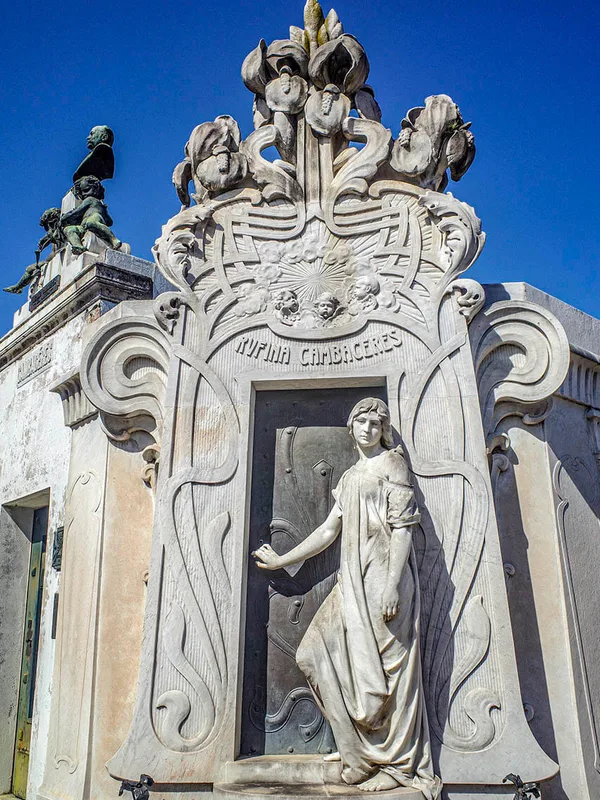
The record. Rufina was born on 31 May 1883, the daughter of Eugenio Cambaceres — novelist, politician, one of the richest men in the country — and Luisa Bacichi, an Italian dancer. Her father died when she was four. She died on 31 May 1902, her nineteenth birthday, in the family home; three doctors certified a cardiac cause, and she was buried the next day in the family vault. Her mother later commissioned the tomb you see: Carrara marble, pure Art Nouveau, irises climbing the frame, and Rufina herself at a half-open door with one hand on the handle, as if about to step out. The sculpture is signed by Richard Aigner.
The story. That she was in fact in a cataleptic coma; that the caretaker heard noises the night after the burial; that the coffin had shifted and the lid, and her face, were scratched from the inside. Some versions have her dressing for an evening at the Teatro Colón, others collapsing on learning a family secret. The sculpture, with its hand reaching for the door, is read as her mother's confession.
Where they part. No contemporary document mentions a reopened coffin; the premature-burial version appears in print decades later, and it belongs to a whole family of such stories from an era genuinely terrified of catalepsy. The versions that send her to the Teatro Colón don't add up: the old theatre had closed in 1888 and the new one opened in 1908, six years after her death. Folklore borrows prestigious settings and smooths the dates. What is true is that the tomb is extraordinary and that a girl touching a door looks like someone about to open it. Art doesn't prove the legend; it keeps it alive. The two rival explanations of why she collapsed that evening — and the name that one of them involves — are told at the tomb on the audio route.
Finding it. Off the main avenues, in the side lanes rather than on the axis from the gate to the crucifix; the carved irises on the frame show from the end of the lane. On the audio route it is stop 8, right after Liliana and before Evita.
2. Liliana Crociati and Sabú
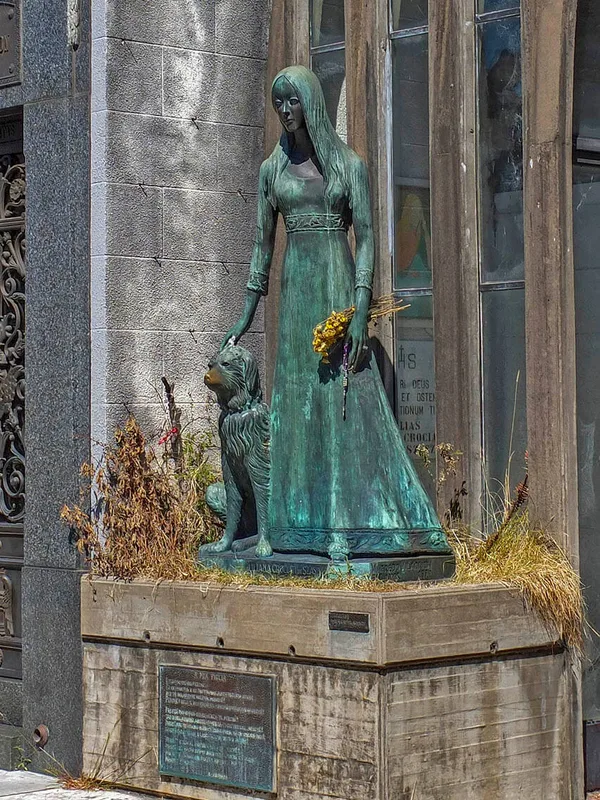
The record. Liliana Crociati de Szászak was 26 when an avalanche hit the hotel where she was staying at Zürs am Arlberg, in the Austrian Alps, on 26 February 1970. Her husband, János Szászak, survived; she did not. They had married in October 1966. Her parents built the tomb: a small neo-Gothic chapel designed by her mother, with tall windows so the inside would not be dark, and in front of it a life-size bronze of Liliana in her wedding dress, by the sculptor Wífredo Viladrich. The dog at her feet is Sabú, her own dog, added later.
The story. That she was on her honeymoon. That Sabú died in Buenos Aires at the very hour of the avalanche, of grief. That rubbing his nose grants a wish — which is why it shines gold against the dark bronze.
Where they part. The honeymoon is a retelling that compresses three and a half years of marriage into a melodrama; the dates are not in doubt. Sabú died several years after Liliana, and his statue was commissioned then, which is why he and she were cast separately. The nose is real and really is polished by thousands of hands; nobody keeps statistics on the wishes. Why her mother chose a wedding dress for the statue, and what is painted inside the chapel, is on the audio route.
Finding it. It's one of very few tombs in Recoleta with a bronze woman standing outside the architecture, so once you're in the right lane you can't miss it; the problem is the lane. On the audio route it is stop 7, between Admiral Brown and Rufina.
3. David Alleno: the caretaker who bought his place
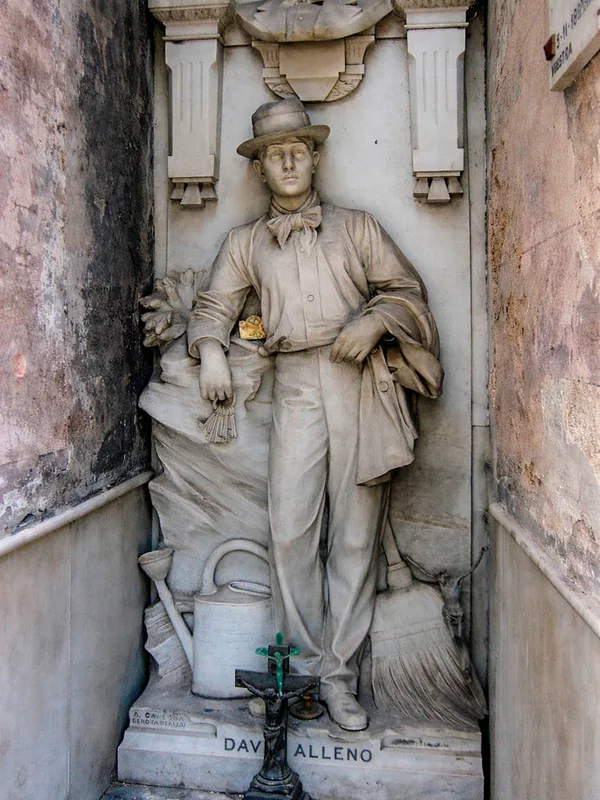
The record. David Alleno, from a family of Italian immigrants, worked as a cuidador — caretaker, gravedigger, sweeper — in Recoleta from 1881 to 1910. For most of that time he saved to buy what his employers had: a plot of his own here. With his savings and a share of a brother's lottery win he bought a small plot and travelled to Genoa, where the sculptor Achille Canessa carved him life-size in Carrara marble, in his work clothes, holding a ring of keys, a broom and a watering can. The inscription reads simply cuidador de este cementerio, 1881–1910. He died on 31 August 1915.
The story. That the day the statue was installed he resigned, went home and shot himself, unable to wait for the grave he had worked thirty years for. Some add that his broom can be heard at night.
Where they part. He retired in 1910 and died in 1915, so the “same day” is out. His death certificate records a head injury without explaining it, and researchers who have gone through the archives found nothing more; the suicide is possible and undocumented. What is documented is remarkable enough: a man who swept these lanes for almost thirty years and ended up carved life-size, broom in hand, among the generals and presidents he worked around. What he said to his employers when the statue arrived — according to the version the guides love — is a stop on the route.
Finding it. This is the one that costs people half an hour. He stands in a narrow lane away from the big avenues, life-size on a low plinth, easy to walk past; the broom is the thing to look for. On the audio route he is stop 12, after Evita and before the boxer Firpo — and the map marks him, which is most of the reason the route exists.
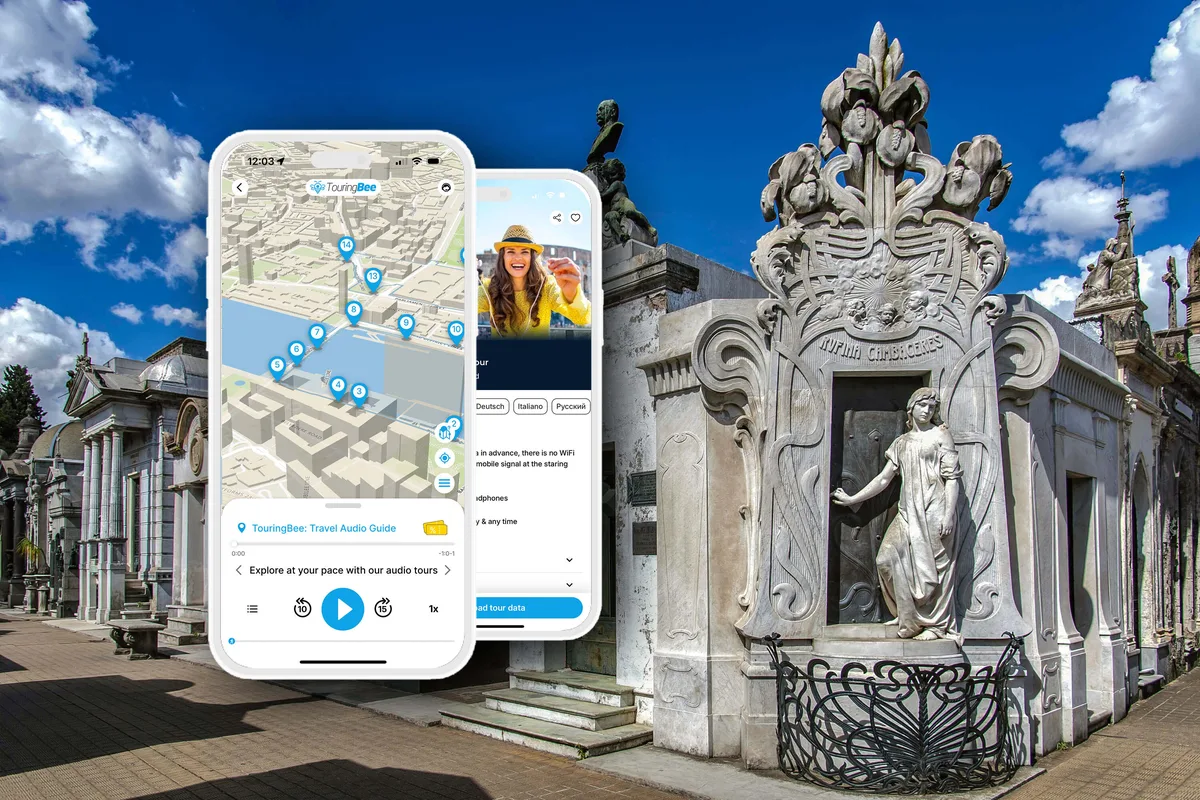
Hear the stories at the tombs themselves
22 stops · ~1.5 h · offline map — from €9.99, one payment, no subscription.
Get the audio guide4. The Lady in White
The record. Luz María García Velloso, daughter of the playwright Enrique García Velloso, died of leukaemia in 1925 at fifteen. Her tomb shows her lying on the lid in a white dress with flowers in her hands, one of the most tender sculptures in the cemetery.
The story. Her mother, it is said, obtained permission to spend nights in the vault. And then the tale proper: a young man meets a girl in white weeping near the cemetery gate at night. He lends her his jacket, takes her for a drink at a café on the square; she gives her name as Luz María and runs off towards the gate. The next day he looks for her inside and finds the jacket draped over a marble girl with her face.
Where they part. This is the “vanishing hitchhiker” tale, told in some form about cemeteries from Mexico City to Manila; in Buenos Aires it attached itself to the most touching young girl's tomb it could find. Some newspapers tell the same story about Rufina. It proves nothing about Luz María and everything about how legends choose their homes. It's not on the audio route; the tomb is worth finding for the sculpture alone.
Finding it. Not on the audio route. Look for a reclining figure rather than a standing one — a girl lying on the lid of the tomb — or ask a caretaker for “Luz María”; they all know.
5. The cats
The record. From the 1990s Recoleta had a colony of cats, at its peak several dozen, fed and looked after by a group of volunteer women who came every day with food and medicine. They slept on the mausoleum roofs, posed for every photographer and became as much a part of the postcard as the angels. In recent years the colony has been deliberately reduced through sterilisation and adoption. In recent visitors' videos and accounts a cat is described as a lucky encounter rather than a fixture of the place: instead of the former dozens, people usually notice just a few.
The story. That they are the guardians of the souls, or the souls themselves; that a cat sitting on a tomb means the occupant is at peace.
Where they part. They're cats. But the first time you see one asleep on a dome in the 9:00 light, with the marble still cold and nobody in the lane, the story makes a certain sense. Don't feed them; the volunteers manage their diet, and the point of the current policy is a small, healthy colony rather than a large hungry one.
Also told in the lanes
- The Argentine Nostradamus. Benjamín Solari Parravicini (1898–1974), painter, who drew “psychographies” that admirers read as predictions of television, the moon landing and much else. His modest tomb is the last stop on the audio route, and his story closes it.
- Doors that don't close. Several vaults have doors that stand ajar or glass panels through which you can see a spiral stair going down to the coffins below. Nothing supernatural: Recoleta's vaults go two or three levels down, and some are in poor repair or no longer looked after by a family. It's one of the most unsettling sights in the cemetery, and entirely real.
- Evita's body. Not a legend, though it sounds like one: embalmed, stolen, hidden abroad under a false name for sixteen years, returned and buried here under steel plates. It has its own page.
From my own visit
I came for the famous names and left thinking about the stories. The thing nobody tells you is how close it all is: Rufina's door, with its irises and the girl's hand, is in a lane most people walk past on their way back to the exit. Liliana's chapel is so unlike everything around it that you feel you've stepped into a different cemetery. And David Alleno cost me thirty minutes — I had a paper map, the lanes all look alike, and his statue is smaller than the legend. When I finally found him, broom in hand, a cat was asleep on the vault opposite. That half-hour is why the audio guide has a map with the stops already on it.
A word about telling these stories
These are real people, not characters in a ghost story, and this is an active cemetery. The stories are part of why Recoleta is loved, and there's no harm in telling them — as long as they're told as stories, quietly, and nobody leans on a door for a photograph. The best guides mark the line between record and legend themselves. So does the audio.
Recoleta Cemetery Self-Guided Audio TourInstant access
- 100% offline — no Wi-Fi or data needed inside the cemetery
- Offline map with the route — you start each story yourself at the tomb
- Audio languages: English, Spanish
- Works on iOS & Android
- 22 stops, about 1–2 hours at your own pace
The takeaway
Rufina died on her birthday and was carved at her door; the rest is a story. Liliana died in an avalanche three years after her wedding; the dog came later. The caretaker bought his place among the generals and died five years on, cause unknown. The Lady in White is a tale that found a tomb. The cats are cats. Each of those sentences is more interesting than the legend it corrects — and the four tombs remain one of the best legend walks Recoleta has.
Hear the stories at the doors, in order, with the route already drawn: Get the audio guide — 22 stops · offline · €9.99
Frequently asked questions
Was Rufina Cambaceres really buried alive?
It isn't documented. What is certain: she died on 31 May 1902, her nineteenth birthday, three doctors certified a cardiac cause, and her mother commissioned an Art Nouveau tomb with Rufina carved at the door. The moved coffin, the scratches and the catalepsy are a story that appears later and has no contemporary source.
Did Liliana Crociati die on her honeymoon?
No. Liliana married János Szászak in 1966 and died in an avalanche at Zürs am Arlberg, Austria, on 26 February 1970 — more than three years later. The honeymoon detail is a retelling. Her dog Sabú did not die the same day either; he died years later and his statue was added afterwards.
Did the caretaker David Alleno kill himself when his tomb was finished?
Unproven. Alleno worked at the cemetery from 1881 to 1910 and had a life-size marble statue of himself made in Genoa. He died in 1915 — five years after retiring — and his death certificate gives a head injury without saying how it happened. The suicide is the guides' version, not the record's.
Who is the Lady in White of Recoleta?
Most versions name Luz María García Velloso, a playwright's daughter who died of leukaemia in 1925 at fifteen and is carved lying on her tomb. The story of the young man who lends his jacket to a crying girl and finds it on her grave the next morning is a classic ghost tale told about several cemeteries; in Buenos Aires it settled on her.
Are there still cats in Recoleta Cemetery?
A few. The colony that once numbered dozens, fed by volunteers since the 1990s, has been deliberately reduced through sterilisation and adoption; in recent visitors' videos a cat is a lucky encounter, not a given. Please don't feed them.
Does the audio guide tell these stories?
Yes — Rufina, Liliana, David Alleno and the “Argentine Nostradamus” Solari Parravicini are four of the 22 stops, told in full at the tombs, with the route between them on an offline map.
Continue exploring
Some links on this page are affiliate links (GetYourGuide, Booking.com, TouringBee). If you book through them we may earn a small commission — at no extra cost to you. It never affects what we recommend. See our Affiliate Disclosure.