
Here is the whole secret in one line: be at the gate on Junín at 9:00. Recoleta Cemetery is rarely crowded the way Mont-Saint-Michel or the Vatican are crowded — four and a half thousand vaults soak up a lot of people — but one narrow lane, the one with the name Duarte over the door, jams solid from mid-morning. Arrive at opening and you have Evita, the angels and the low light to yourself.
The rest of this guide fills in the detail: what each hour of the day is like, which days are quiet, and how the seasons work when you're south of the equator. Because the best hour is the one before the groups come, it's also the hour for which a self-guided audio guide makes most sense — no departure time to wait for, just walk in.
Still planning the whole trip? Start with our complete guide to Recoleta Cemetery, then come back here to pick your moment.
Best time at a glance
Get the audio guide →
The best time of day, hour by hour
9:00 — opening
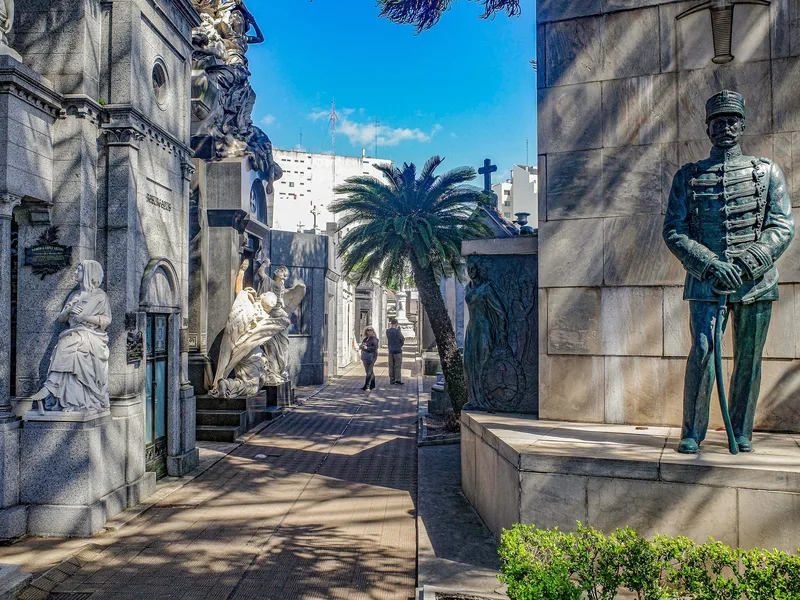
Tourist entry starts at 9:00 (the gate for families opens earlier; that door is no longer open to visitors). For the first hour the cemetery belongs to a handful of photographers, a caretaker with a broom and, if you're lucky, a cat on a dome. The sun is low and comes in sideways, which is what carved stone wants: reliefs stand out, inscriptions become legible, and the east-facing façades are at their best. Head for Evita first if she's your priority — this is the one hour her lane is quiet — or follow the route in order and reach her around 9:40, still before anyone else.
10:30–15:00 — the groups
By half past ten the coach tours and the hourly free walks are inside, and by noon three or four groups can be queuing in Evita's lane at once. A five-minute stop becomes twenty-five. In summer the marble radiates heat and there's no shade in the narrow lanes, no café, no water inside. If this is the only time you can come, do the far lanes first — the boxer, the Nobel laureate, the caretaker — and drop back to Evita after 15:00.
15:30–17:00 — the second window
The groups leave, the light swings west, and vault interiors that were dark all morning — Adolfo Bioy Casares' among them — light up through their glass doors. It's the best hour for looking inside. Just don't cut it fine: be through the gate by 16:00, because staff start clearing the lanes towards closing.
The best day of the week
Midweek is quietest. Saturdays and Sundays bring Argentine families (who enter free), the craft fair on Plaza Francia next door, and more of the hourly free tours — they start at 9:00 at weekends instead of 10:00, which eats into your quiet hour. If you can only come at the weekend, be there at 9:00 and go straight to Evita. Argentine public holidays behave like Sundays; 26 July, the anniversary of her death, and 17 October, Peronist Loyalty Day, fill the Duarte lane with flowers and pilgrims — moving to witness, impossible to photograph in peace.
Hear the stories at the tombs themselves
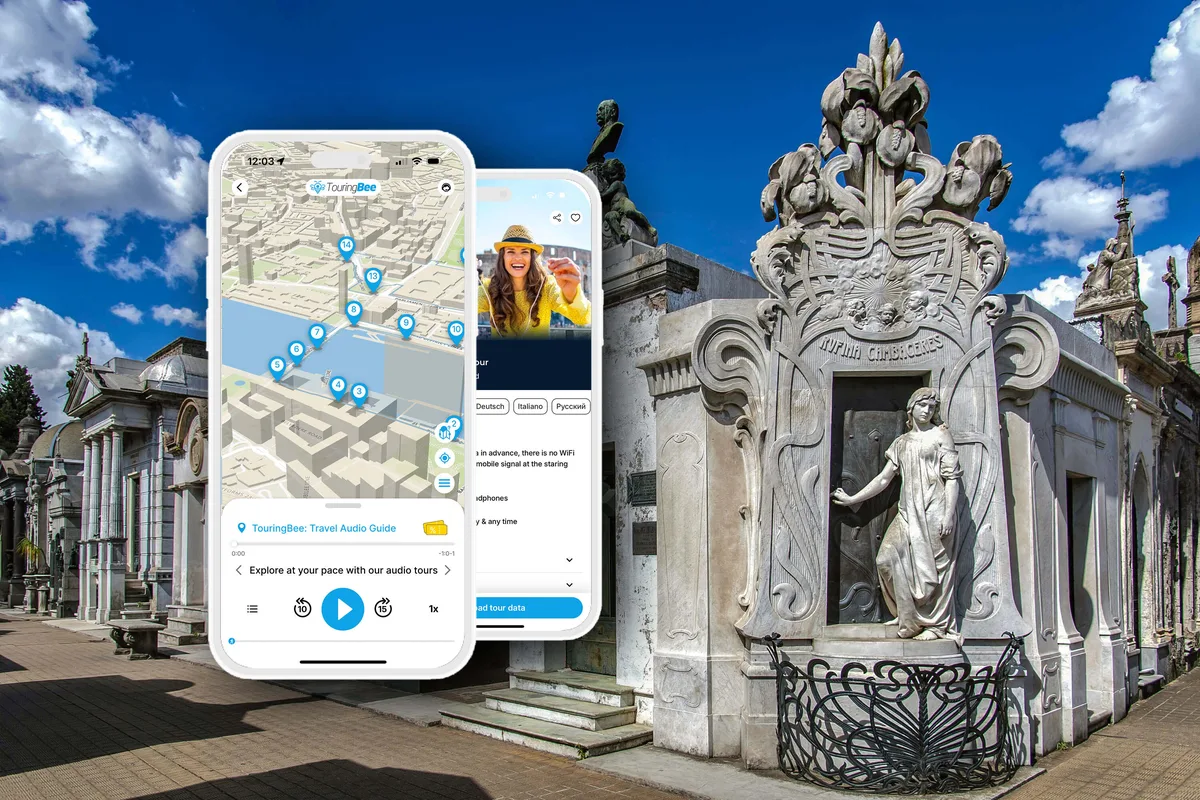
22 stops, offline map, English or Spanish narration — from €9.99, one payment, no subscription.
Get the audio guideThe best season — and the hemisphere trap
Buenos Aires is south of the equator, so the calendar is upside down for most of our readers. Christmas is high summer; July is the middle of winter. Every year visitors arrive in January with a jumper, or in July with sandals.
Spring: September to November
The best season. Mild days, clear light, and in November the city's jacarandas flower purple — there are some at the edge of the cemetery and many on the avenues around it. Warm enough for the lanes, cool enough to walk for two hours.
Summer: December to February
Hot and humid, often above 30 °C, and the cemetery's stone amplifies it. This is when the 9:00 rule stops being advice and becomes survival: by midday the narrow lanes are an oven with no shade. Bring water and a hat; there's nothing to buy inside. January is also when many porteños leave town, so the city is quieter.
Autumn: March to May
The other sweet spot. Soft light, comfortable temperatures, fewer visitors than spring. April is lovely.
Winter: June to August
Mild rather than cold — think 8–15 °C, grey some days, bright others. The cemetery is at its quietest, the low winter sun is flattering to the sculpture all day, and you'll rarely queue anywhere. Pack a proper coat: Buenos Aires damp gets into the bones.
Rain, heat and closures
The cemetery is open every day of the year, 9:00 to 17:00. It doesn't close for rain, but wet marble and old paving are slippery, and staff may close individual lanes. In a downpour, do the basilica next door (free) and La Biela across the square and come back when it passes — wet stone photographs beautifully. Funerals and family ceremonies take priority at any hour; if a lane is in use, yield it and come back.
If you're here for the photos
Morning for east-facing façades and the portico; late afternoon for west-facing interiors through glass; overcast days for the bronze (no glare); after rain for reflections in the lanes. Stand off-axis and shade the lens to beat reflections in the doors. And at Evita's vault, make room before you make a picture.
Putting it together: the ideal half-day
- 8:45 — Coffee at La Biela, under the giant gomero tree, with the ticket already bought on Entradas BA.
- 9:00 — Through the portico. Audio guide already downloaded on hotel Wi-Fi.
- 9:00–10:45 — The 22-stop route, Evita around 9:40, in your own time.
- 10:45 — Out before the groups. Basilica next door (free), then the cloister museum if you like.
- 11:30 — Centro Cultural Recoleta, the Bellas Artes museum, or the Floralis Genérica — all within ten minutes' walk.
Recoleta Cemetery Self-Guided Audio TourInstant access
- 100% offline — no Wi-Fi or data needed inside the cemetery
- Offline map with the route — you start each story yourself at the tomb
- Narrated in English and Spanish
- Works on iOS & Android
- 22 stops, about 1–2 hours at your own pace
The takeaway
Nine o'clock, midweek if you can, spring or autumn if you can choose. Everything else — the fee, the route, the stories — matters less than that first hour with the lanes to yourself.
The audio guide is built for exactly that hour: no group to wait for, an offline map, and 22 stories in English or Spanish that start when you do. Get the audio guide — €9.99
Frequently asked questions
What time should I arrive at Recoleta Cemetery?
9:00, when tourist entry opens. The lanes are empty, the light is low on the marble, and Evita's vault has no queue. By 10:30 the groups arrive.
What's the busiest time?
Roughly 10:30 to 15:00, especially around midday, when several guided groups converge on Eva Perón's narrow lane at once. Weekends and Argentine holidays are busier than weekdays.
Is late afternoon good?
Yes — after 15:30 the groups thin out and the west-facing interiors light up through the glass. Arrive by 16:00 at the latest; the tourist window closes at 17:00.
What's the best season to visit Buenos Aires?
Spring (September–November) and autumn (March–May): mild, bright, jacarandas in November. Summer (December–February) is hot and humid — the marble lanes become an oven at midday. Winter (June–August) is mild and quiet.
Are the seasons really reversed?
Yes. Buenos Aires is in the Southern Hemisphere: Christmas is high summer, July is mid-winter. Northern visitors regularly pack for the wrong hemisphere.
Does the cemetery close for rain or holidays?
It's open 9:00–17:00 every day of the year. Heavy rain makes the paving slippery and can close individual lanes; funerals and ceremonies take priority over tourist access at any time.
Continue exploring
Some links on this page are affiliate links (GetYourGuide, Booking.com, TouringBee). If you book through them we may earn a small commission — at no extra cost to you. It never affects what we recommend. See our Affiliate Disclosure.