
Recoleta Cemetery: A Complete Guide to Evita's Tomb, the Legends & How to Visit
Tickets, hours, how to find the famous graves — plus a self-paced audio tour for the walk itself.
Hear the guide before you go
A short sample — the same voice that walks you from the portico to the far lanes.
What Is This Tour?
A self-guided audio tour you play on your phone as you walk. An offline map shows where you are and where the next tomb is; you start each story yourself when you reach it — so your eyes stay on the marble angels, not on a screen. Buy once, use offline, keep it for a year.
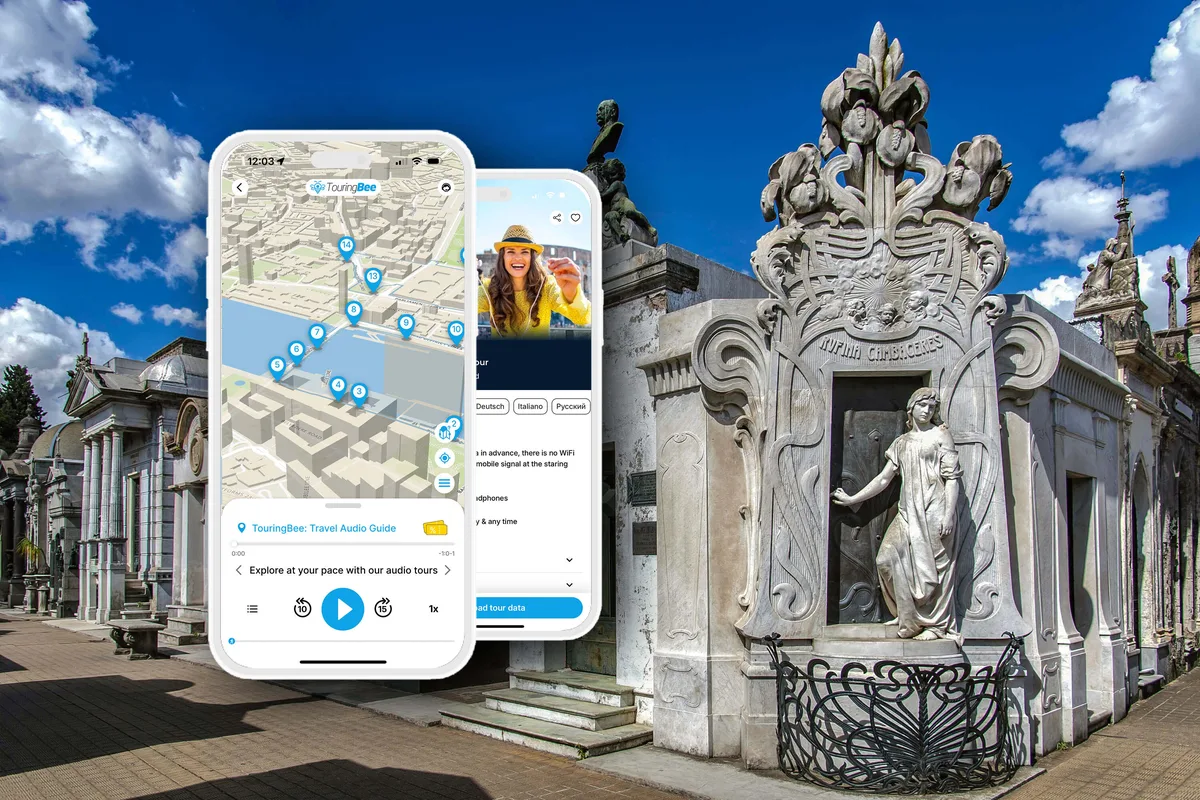
Recoleta Cemetery Self-Guided Audio TourInstant access
- 100% offline — no Wi-Fi or data needed inside the cemetery
- Offline map with the route — you start each story yourself at the tomb
- Narrated in English and Spanish
- Works on iOS & Android
- 22 stops, about 1–2 hours at your own pace
Why Visit Recoleta Cemetery?
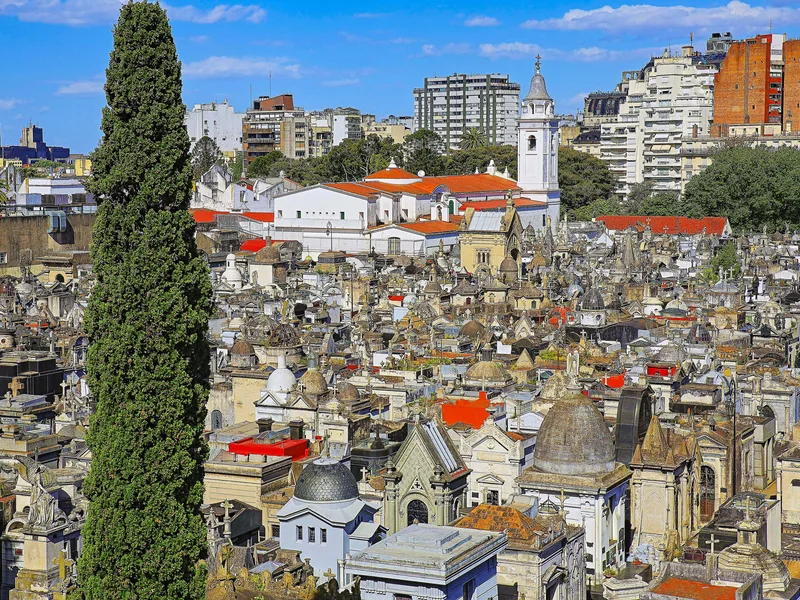
Recoleta is not a cemetery with a few famous graves. It is a city inside a city: 4,600 vaults and mausoleums on five and a half hectares, laid out in streets and blocks, with corner plots, domes, stained glass and marble angels — and the most visited grave in Argentina hidden in a side lane, marked only with the name “Duarte”.
Presidents, generals, Nobel laureates, an Irish admiral, a champion boxer, a caretaker who saved for decades to be buried among them, and a girl whose legend says she woke up inside her coffin. That is the cast. The setting is the most elegant neighbourhood of Buenos Aires, where the city decided in the 1880s to look like Paris and then built its dead a Paris of their own. This guide walks you through what Recoleta is, why it looks the way it does, when to come, how much it costs, and how to see the best of it without a group — the TouringBee audio tour does the storytelling on the spot.
The Story of Recoleta Cemetery
From a Friars' Orchard to the First Public Cemetery
The name comes from the Recollect Franciscans — los Recoletos — who settled on what was then the edge of Buenos Aires in the early 1700s and built the Basílica del Pilar, still standing next door. In 1822 a reforming government dissolved the order and turned the friars' garden into the city's first public cemetery. Burial had just been banned inside churches; this was the modern, civic alternative. The first people laid to rest here, a city chronicle records, were a child of freed slaves and a woman called María Dolores Maciel. The exclusive necropolis came later.
1871: Yellow Fever Moves the Rich North
In 1871 yellow fever tore through the crowded southern districts of Buenos Aires. Whoever could afford it fled north to the high ground of Recoleta — and never went back. The neighbourhood became the address of the elite, and its cemetery became their final one. Argentina was on its way to being one of the richest countries on earth; the French still say riche comme un Argentin. Families competed in marble the way they competed in mansions. A plot with a vault could cost as much as an apartment in the centre.
1881: A City for the Dead, With Streets and Corners
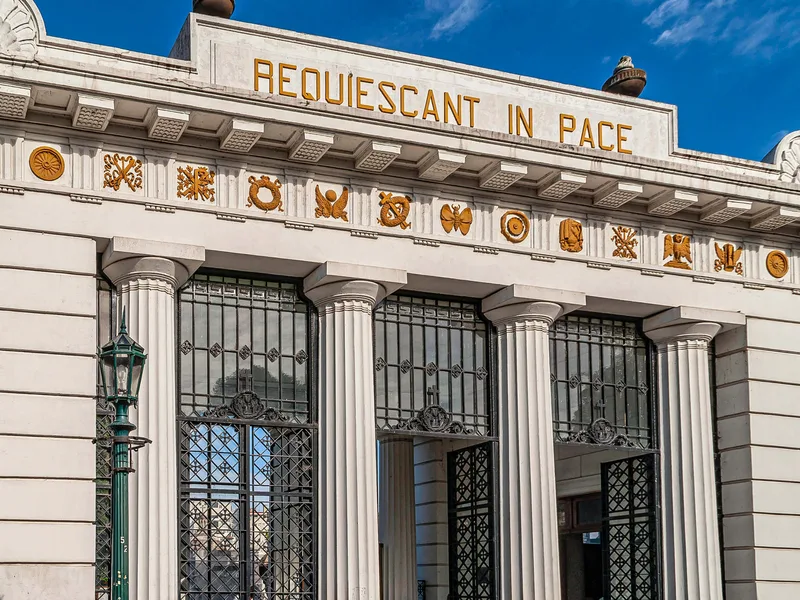
The Recoleta you walk today is largely the work of one decade. In 1881 the mayor, Torcuato de Alvear, ordered a full redesign, and architect Juan Antonio Buschiazzo gave the cemetery its neoclassical portico, its paved avenues and its blocks of family vaults facing the lanes like town houses. Read the gate before you go in: Requiescant in pace above the columns, an owl, an hourglass with wings, a snake biting its tail. The whole cemetery is written on that door.
Hear these stories at the tombs themselves — 22 stops, in the right order. From €9.99 · offline · in English
Get the Audio GuideEva Perón's Longest Journey
Evita died of cancer in 1952 at 33, and the country wept in the streets. Her embalmed body was meant for a monument; instead, after the 1955 coup, it vanished. For sixteen years it was hidden, moved between offices and attics, and finally buried under a false name in Milan. Juan Perón recovered it in Madrid in 1971. It came home to Argentina in 1974 and, in 1976, was placed in the Duarte family vault at Recoleta — several metres down, behind heavy plates, in one of the most guarded graves in the world. The vault itself is modest. The flowers, the notes and the crowds are the monument. How to find Evita's tomb →
The Legends: a Girl at a Door, a Bride and Her Dog, a Caretaker's Dream
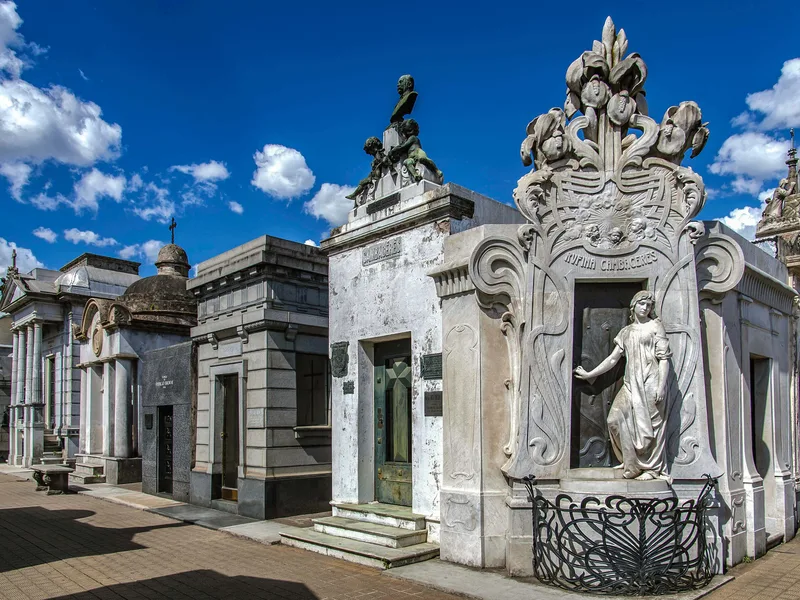
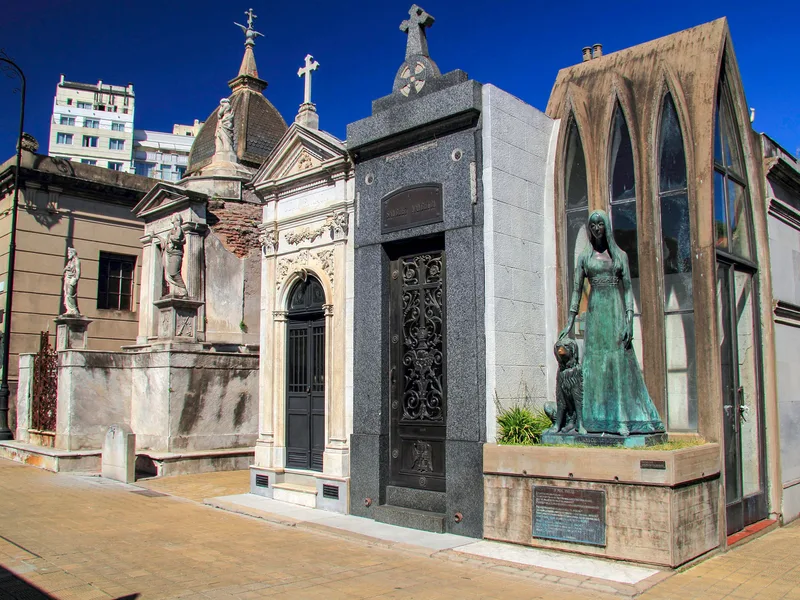
Every cemetery has stories; Recoleta's are unusually good, and the sculpture keeps them alive. Rufina Cambaceres died in 1902 on her nineteenth birthday; her Art Nouveau tomb shows her with one hand on the door, and the city has told the story of her waking inside the coffin ever since. Liliana Crociati was killed by an avalanche in Austria in 1970; her mother designed a neo-Gothic chapel with a bronze Liliana outside it, her dog Sabú at her feet, his nose polished gold by visitors' hands. David Alleno, a caretaker, saved for years to buy his own plot among the presidents and had himself carved with his keys, broom and watering can. We tell you which parts are documented and which are legend — the truth is usually more interesting.
Funerary Art: Four Styles on One Street
Stand at a crossing and you can see neoclassical columns, a neo-Gothic spire, an Art Nouveau woman with flowing hair and an Art Deco slab in a single glance. Italian sculptors worked here — Giulio Monteverde carved the chapel's crucifix, Victor de Pol put a condor on top of President Sarmiento's obelisk — and so did Lola Mora, Argentina's most famous sculptor. Look for the Egyptian-flavoured Art Deco vaults and for the doors: the hourglass, the inverted torch, the wreath, the butterfly. Each one is a sentence about the family inside.
Planning Your Visit
How Long You Need
Forty-five minutes covers the essentials: the gate, the central Christ, Sarmiento, Evita, Rufina. Ninety minutes is the sweet spot for most people. Give it two to three hours if you like reading doors and comparing styles. The lanes look alike, and a ten-minute crossing easily becomes forty once a bronze face catches your eye — which is exactly why an offline map helps.
Best Time to Come
Be at the gate at 9:00. The cemetery is empty, the light is low and warm on the marble, and you'll have Evita's lane to yourself. By 10:30 the coach groups arrive and the narrow passages jam. The last hour before 17:00 is the second-best window. Remember the seasons are reversed: December to February is high summer, hot and humid on the stone; June to August is mild. Best time to visit →
Tickets and the Entry Fee
Foreign visitors pay an entry fee; Argentine residents don't. Buy online on the City's Entradas BA site or at the gate with a card — the peso price changes with inflation, so check the official figure the week you travel. Free guided walks in Spanish leave the gate every hour. Full ticket guide →
Where to Stay
Recoleta itself is the classic choice: quiet, walkable, five minutes from the cemetery and the cafés of Plaza Francia. Palermo is livelier and a short taxi away. Check hotels in Recoleta on Booking.com →
What You'll Discover on the Tour
A handful of the stops waiting inside the walls — the full 22-stop route unfolds in the guide as you walk.
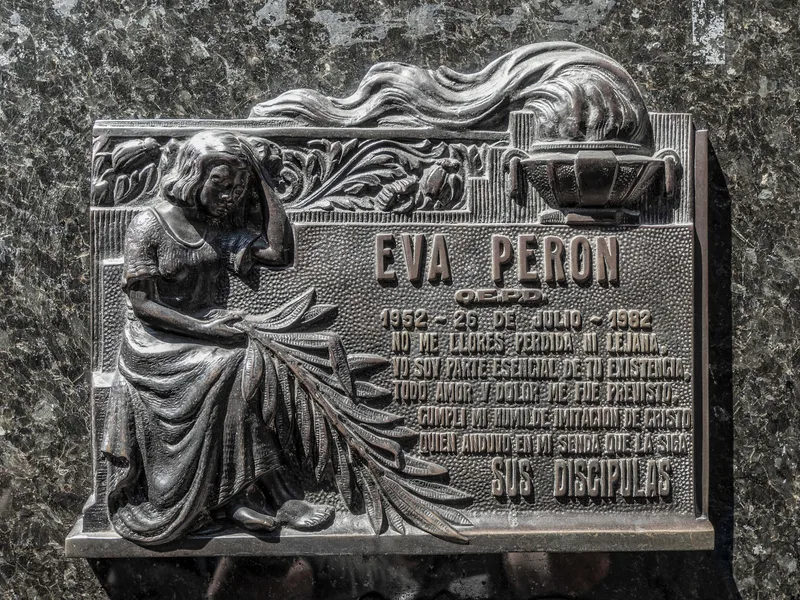
Eva Perón
Why her body spent 16 years in hiding, and why the vault says “Duarte”.
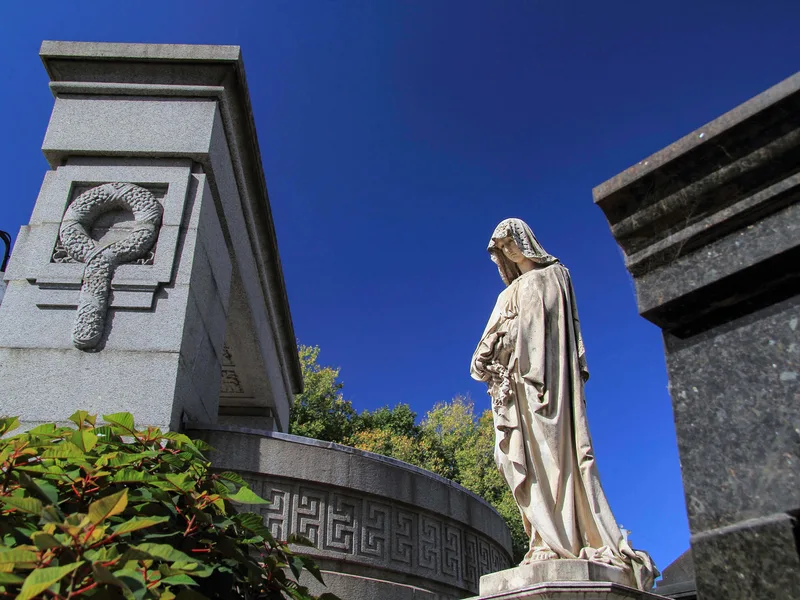
Rufina Cambaceres
The girl at the door — and what the evidence actually says about her death.
The Portico
Owls, hourglasses and a snake biting its tail: the cemetery in one doorway.
Admiral Brown
An Irishman, a green column cast from cannons, and the day he let Garibaldi run.
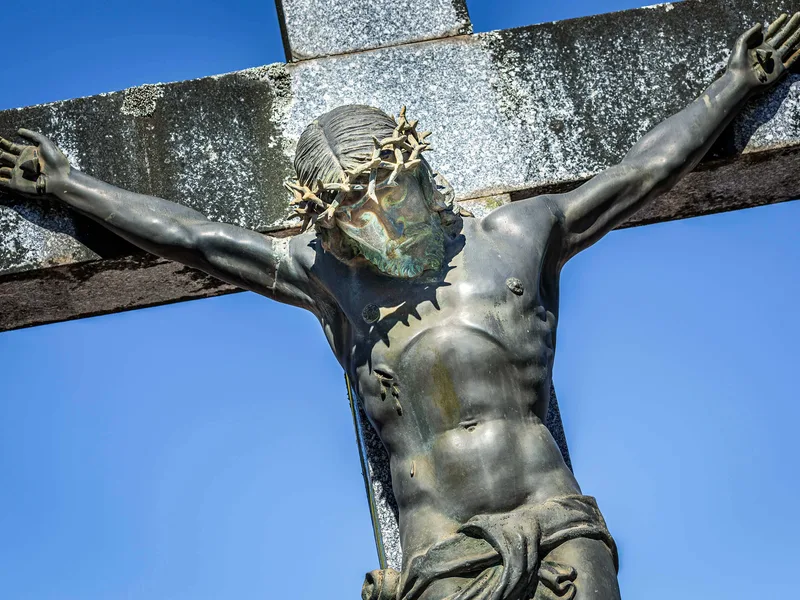
The Central Christ
Where the avenues cross — your compass in the maze.
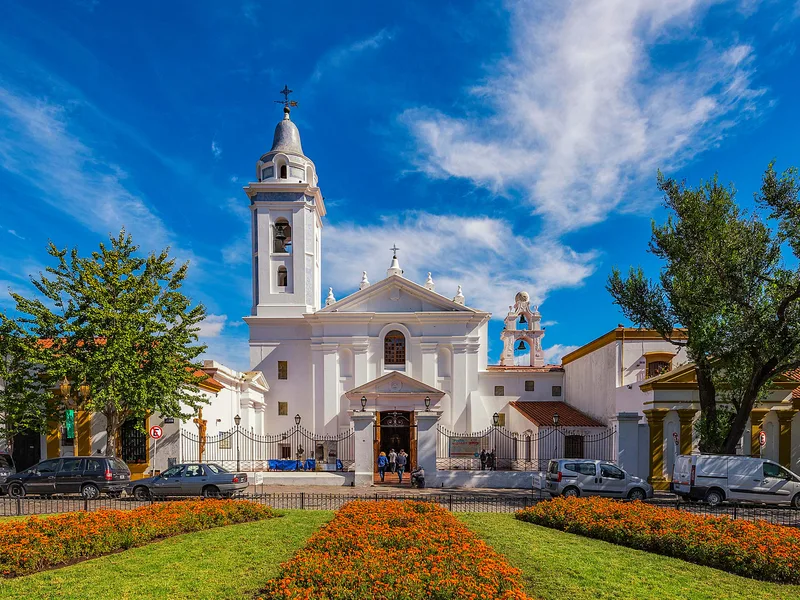
Basílica del Pilar
The 1732 church the cemetery grew out of, and the quarrel that made Recoleta secular.
How the Audio Tour Works
Buy the guide
One payment, instant access by email. No subscription.
Download the app
Get the TouringBee app on iOS or Android and download the tour before you go — signal is weak between the vaults.
Start at the gate
Open the guide at the portico, follow the offline map, and start each story yourself when you reach the tomb.
Pause & resume
Go at your own pace, sit in the shade, and pick up wherever you left off.
Visiting Recoleta Cemetery
Recoleta Cemetery — Entry Ticket
Official city ticket · buy online or at the gate · Argentine residents enter free
About ARS 24,000 · non-resident adult · card or QR payment
- Sold by the City of Buenos Aires through Entradas BA — no third-party mark-up
- Show the e-ticket on your phone at the turnstiles
- Free guided walks in Spanish leave the gate every hour
The peso price changes with inflation — the official site always shows today's figure.
Book Guided Tours & Buenos Aires Experiences
Prefer a live guide, or want to add a tango night or a day on the Tigre Delta? Compare our trusted partners — same prices you'd pay direct.
Some links below are affiliate links (GetYourGuide, Booking.com). If you book through them we may earn a small commission — at no extra cost to you. It never affects what we recommend.
More Audio Tours by TouringBee
Going on to Europe? The same app, the same voice-led format.
Père-Lachaise, Paris
View tour →The Louvre
View tour →Montmartre
View tour →Mont-Saint-Michel
View tour →Plan Your Visit
- Eva Perón's tomb: how to find it — Where the Duarte vault is, what you'll see, and the 24-year journey of her body.
- Tickets, entry fee & hours — The fee for foreign visitors, who goes free, how to pay, hours and the free tours.
- A self-guided route through the maze — A 22-stop route from the portico to the far lanes — in the right order.
- Guided tour vs audio guide vs solo — What each format costs, what you get, and which one fits your day.
- Best time to visit — Why 9:00 matters, when the coaches arrive, and the seasons turned upside down.
- All Recoleta guides →
Frequently Asked Questions
Is Recoleta Cemetery free to visit?
Not for foreign visitors. Since 2022 the City of Buenos Aires charges non-residents an entry fee (around ARS 24,000 in 2026, paid by card or QR). Argentine residents enter free with their ID. Tickets are sold online on the official Entradas BA site and at the gate.
What are the opening hours?
9:00 to 17:00, every day of the year. Free guided walks in Spanish leave the main gate every hour — from 10:00 on weekdays and from 9:00 at weekends and holidays.
How do I find Eva Perón's tomb?
She lies in the Duarte family vault — look for “Familia Duarte”, not “Perón” — in a narrow side lane a few minutes from the entrance. Our Evita article has step-by-step directions; the audio guide's offline map takes you straight there.
How long does a visit take?
Around 45 minutes for the essentials, 90 minutes for a proper walk, up to 2–3 hours if you love architecture and stories. The audio tour's 22 stops take about an hour and a half at a relaxed pace.
Is the audio guide available offline?
Yes. Download it once in the TouringBee app and it works fully offline — useful, because the tall marble lanes block mobile signal.
What languages is the audio guide in?
English and Spanish. This website is available in eight languages, but the audio narration for this tour is recorded in English and Spanish.
Does it work on iPhone and Android?
Yes, the TouringBee app runs on both iOS and Android.
How do I get to Recoleta Cemetery?
Subte line H to Las Heras, then a 10-minute walk; or a colectivo to Avenida Las Heras y Junín. Taxis, Uber and Cabify drop you at Junín 1760, right by the gate. From the centre it's a pleasant 30–40 minute walk.
Is it an active cemetery?
Yes. Families still visit, funerals still take place, and caretakers work in the lanes every day. Keep your voice down, don't touch doors or sculptures, and step aside for mourners.
About the Author

This guide is written by Eugene, a former tour guide and founder of the travel-content network paris10.travel, who has spent years writing about cemeteries, from Père-Lachaise in Paris to Recoleta in Buenos Aires, and produces TouringBee's self-guided audio tours. Every fee, hour and date here is checked against the City of Buenos Aires' official pages and the Recoleta research archive, not copied from other blogs.
The aim is simple: to leave you more confident, more curious and better prepared than you were five minutes ago — and, if you want the full story on the spot, to walk it with you through the app.
Walk Recoleta With Every Story in Your Ears
Evita, the admiral, the boxer, the girl at the door — told at the tombs themselves, at your own pace.
Get the Audio Tour — from €9.99