
People arrive at Recoleta Cemetery expecting a shrine: a dome, an angel, a queue of a thousand. What they find is a narrow lane, a dark granite door with the name Duarte above it, bronze plaques, and a few fresh roses tucked into the grille. That modesty is the first surprise of Eva Perón's tomb. The second is how hard it is to find without help.
This guide gives you the directions, tells you what you're looking at when you get there, and explains why one of the most famous women of the twentieth century lies under her maiden name, several metres below a side street of the dead. If you'd rather hear it on the spot, the TouringBee audio guide takes you straight to the vault on an offline map and tells the story while you stand in front of it.
Still planning the whole trip? Start with our complete guide to Recoleta Cemetery, then come back here for the Evita details.
Evita's tomb at a glance
Get the audio guide →
How to find Eva Perón's tomb
Recoleta is a grid of lanes that all look alike, and mobile signal drops between the tall marble walls. Every year visitors spend half an hour wandering before they give up and follow a tour group. Here is the reliable method.
- Enter through the main portico on Junín and walk straight ahead down the central avenue. You'll pass the Pantheon of Meritorious Citizens on your way.
- Reach the central crucifix — the big white Christ where the main avenues cross. This is your compass for the whole cemetery.
- Turn left at the crucifix and follow the avenue for a few short blocks. The vault is in one of the narrow side lanes off this avenue, where the vaults stand shoulder to shoulder. In daytime you'll rarely need more than that: look for the small crowd, the flowers and the phones held up.
- Look for “Familia Duarte” in bronze letters above a dark door. If you're searching for “Perón”, you'll walk straight past it.
There are small signs near the entrance and staff at the gate will point you the right way. But the simplest option is a map that works with no signal: the audio guide marks the vault as stop 10 of 22 and gets you there without asking anyone.
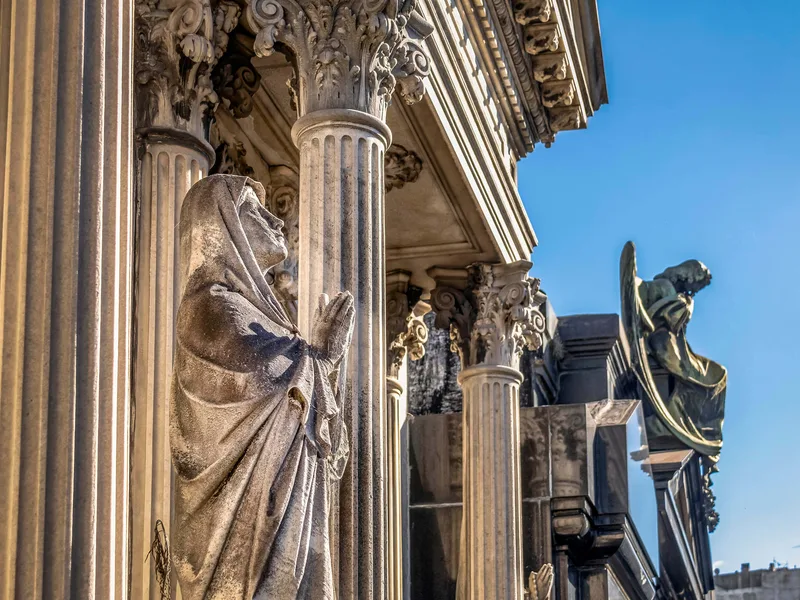
What you'll see at the vault
The vault is small and dark, squeezed between neighbours in a lane barely two people wide. Its power is in what visitors add. Bronze plaques cover the façade: from trade unions, from the taxi drivers of Buenos Aires, from Peronist groups, from admirers who simply came. One of the best known quotes her own words: “Don't cry for me, I am not lost or far away... I am an essential part of your existence.” Roses are pushed through the grille. Handwritten notes appear and are quietly removed. On 26 July, the anniversary of her death, the lane fills.
Below all this is engineering. After everything that happened to her body, the family and the authorities were not going to risk it again: the coffin lies in a chamber several metres down, sealed behind heavy plates and locks that a guide will happily compare to a bank vault. Whether every dramatic detail you hear about it is true is hard to verify; the documented journey of her body is extraordinary enough without embellishment.
Who was Evita? The short version
Eva María Duarte was born in 1919 in the province of Buenos Aires, the illegitimate daughter of a rancher and his mistress. At fifteen she left for the capital to act. She toured with a theatre troupe, played in radio melodramas, and by her early twenties was one of the best-paid radio voices in the country. In 1944, at a charity event for earthquake victims, she met a 48-year-old colonel and minister named Juan Perón.
He became president in 1946; she became something Argentina had never seen. She toured Europe as an unofficial ambassador, traded her film-star wardrobe for a severe bun and Dior suits, built hospitals and children's homes through her foundation, and pushed through the vote for women in 1947. To the poor — her descamisados, the shirtless ones — she was a saint. To the old elite whose cemetery this is, she was an upstart. In 1951 she was offered the vice-presidency and turned it down; she was already ill. She died of cancer on 26 July 1952, aged 33. Millions filed past her coffin; people were crushed in the crowd.
Hear the stories at the tombs themselves
22 stops, offline map, English or Spanish narration — from €9.99, one payment, no subscription.
Get the audio guideThe 24-year journey of her body
Her death was only the beginning of the story that brought her here. Perón had her embalmed by a Spanish specialist — a process that took months and produced a body that looked, witnesses said, as if she were asleep. A monument taller than the Statue of Liberty was planned. It was never built.
- 1955. A military coup sends Perón into exile. The new regime sees the body as dangerous: a relic that could rally the Peronists. Soldiers remove it from the union headquarters where it lies.
- 1955–1957. The body is hidden in Buenos Aires — in offices, a van, an attic. Legend says the officer guarding it slept with a loaded pistol and one night shot his pregnant wife, mistaking her for an intruder. The story is repeated on every tour; treat it as legend.
- 1957. Under a false name, María Maggi de Magistris, the body is secretly buried in a cemetery in Milan.
- 1971. The military, hoping to calm the country, exhumes it and delivers it to Perón in Madrid. He keeps it in his house.
- 1974. Perón, president again, dies. His widow Isabel has Eva's body flown back to Argentina and displayed beside his.
- 1976. A new junta wants the matter closed. The body is handed to the Duarte family and placed in their vault at Recoleta — behind the security you now stand in front of.
So: sixteen years missing, two continents, a false name, and finally a side lane in the cemetery of the very class that despised her. Juan Perón is not here. He is buried at his family's estate in San Vicente, outside the city.
Visiting respectfully
This is a working cemetery and, for many Argentines, a place of real mourning. The lane at the Duarte vault is narrow, so read the plaques, take your photo and step aside. Don't move or touch the flowers. If someone is praying or leaving a note, give them the space. Photography of the vault is fine; photographing mourners is not. And keep your voice down — the acoustics between the marble walls carry every word.
When to go
Arrive at 9:00 when the gates open and you'll have the lane almost to yourself, with low morning light on the bronze. From about 10:30 the coach groups arrive, and by midday a queue of guides with raised umbrellas forms in the lane; a visit that should take five minutes can take twenty-five. After 15:30 it thins again. The last hour before closing is lovely. For the full picture of hours and seasons, see best time to visit Recoleta Cemetery.
Don't stop at Evita
Most people find the Duarte vault, take the photo and leave. Within two hundred metres are the tombs that make Recoleta worth the ticket: Rufina Cambaceres with her hand on the door; Liliana Crociati in her wedding dress with her dog; the caretaker David Alleno carved with his broom; the boxer Luis Ángel Firpo standing in his robe; Admiral Brown's green column. Our self-guided route strings them together in the right order — and the audio guide tells each story as you reach it.
Recoleta Cemetery Self-Guided Audio TourInstant access
- 100% offline — no Wi-Fi or data needed inside the cemetery
- Offline map with the route — you start each story yourself at the tomb
- Narrated in English and Spanish
- Works on iOS & Android
- 22 stops, about 1–2 hours at your own pace
The takeaway
Look for “Duarte”, not “Perón”. Go at 9:00. Read the plaques, step aside, and then keep walking — Evita is the reason most people come to Recoleta, but she is one story among four and a half thousand.
If you'd like those stories told at the tombs themselves, the TouringBee audio guide walks you from the gate to Evita and on through 22 stops, offline, in English or Spanish, at your own pace. Get the audio guide — €9.99
Frequently asked questions
Where exactly is Eva Perón buried?
In the Duarte family vault in Recoleta Cemetery, Buenos Aires. The vault carries her maiden name — “Familia Duarte” — not “Perón”. It sits in a narrow side lane a few minutes' walk from the main entrance; follow the flowers and the small crowd, or use the offline map in the audio guide.
Is Evita's tomb free to see?
It's inside the cemetery, so you need a cemetery ticket. Non-residents pay an entry fee (around ARS 24,000 in 2026); Argentine residents enter free with their ID. There is no separate charge for the tomb.
Why does the tomb say Duarte and not Perón?
Eva was born Eva María Duarte. When her body finally came back to Argentina in the 1970s it was placed in her own family's vault, alongside her mother and siblings, rather than in a Perón mausoleum. Juan Perón is buried elsewhere, in San Vicente.
Can you go inside the vault?
No. Like every vault in Recoleta it is private property, and Evita's is one of the most secure graves in the world: her coffin lies several metres below ground behind heavy plates. You view the façade and the plaques from the lane.
What is the best time to visit Evita's tomb?
9:00, when the gates open, or after 15:30. Between about 10:30 and 15:00 guided groups queue in the lane and you may wait 15–20 minutes just to reach the door.
How long did it take for her body to come to Recoleta?
Twenty-four years. She died in July 1952; her body was seized after the 1955 coup, hidden for 16 years, buried under a false name in Milan, returned to Juan Perón in Madrid in 1971, brought back to Argentina in 1974 and placed in the Duarte vault in 1976.
Continue exploring
Some links on this page are affiliate links (GetYourGuide, Booking.com, TouringBee). If you book through them we may earn a small commission — at no extra cost to you. It never affects what we recommend. See our Affiliate Disclosure.